Monday, July 20, 2026

Contaprox and the Nikon Zf

 One of things I like about the new Z-mount, mirrorless cameras is their ability to mount many different vintage lenses and still retain infinity focus.


Here is an example. Zeiss-Ikon offered a number of different options for closeup work with their Contax rangefinder cameras. Since photographers seldom think of a Contax as a camera for closeup work, these accessories are rare and seldom seen. One such accessory is the Contaprox, sold for use with the Contax IIa and IIIa in the 1950s. It came as a kit in a faux leather box complete with an extension tube, a ground glass and focuser. The lens is a 50mm f3.5 Tessar offering a focus range from infinity to approximately 1:2 reduction. To use it on a Contax, one mounts it on a tripod, focuses with the ground glass, removes the glass and mounts the camera on the lens, calculates the exposure compensation, if going really close, then takes the picture.

However, on a Nikon Zf, all is easy. I mount the lens on a Nikon S converter tube, set camera controls to manual, focus and shoot. I do not have to concern myself with exposure and handheld shots are easy.


Lamb's ears in bloom

Dancing Columbine
Milkweed in bloom


80~200mm ZoomNikkor variations

Differences between an early and late model 80~200 Zoom-Nikkor f4.5 from the 1970s. 

Nikon has never been afraid to make changes to its products, often without any public acknowledgement that a change has occurred. Here our two lenses with the same product description, yet they differ in many ways. 

Numbers 
116946 vs. 773958

Older lens on right


Physically, the two lenses appear similar. Both are the same length and have the same girth. Both focus down to the a little less than six feet or 1.8 meters.
Yet they are very different in many small ways.
• The early lens weighs 29.45 ounces. 
    The later one, 27.65 ounces—a noticeable difference.
• Early lens is 68mm across the front.
    Later lens is 64mm across front, and it looks slimmer.
• The older lens has a separate ring in front flush with main lens body—locked in place with one tiny screw.
    Newer lens is one part from face ring all the way back under focus/zoom ring.
Neither lens uses the NKJ mark. They are just marked Nikon.
• The finish of the early lens is a black, high gloss.
    Later lens has a duller shine.
• The early marking is “ Nikon Zoom – Nikkor Auto 1:4.5 f = 80mm~ f = 200mm 116946.
    Later one is marked just: Nikon Zoom–Nikkor  80~200mm 1:4.5 773958.
    The “Auto” is gone and the aperture/focal length information is reversed and only the 200 length shows “mm.”
• The lettering on the newer lens is at least half a millimeter smaller—a noticeable difference.

Older lens on right 


• Distance on older lens is in ‘feet’ and ‘m’. 
    Newer lens: ‘ft’ and ‘m.’
• Both have apertures down to f32. 
    Older one has color-coded apertures for f32: pale blue, f22: yellow, f16: pink, f11: tan, 
    and f4.5: pale green.
    Newer lens apertures are color-coded for f32: pale blue, f22: yellow, f8: pink and f4.5: pale green. Other apertures are in white.
• Diamond pattern aperture ring is part of the aperture numbers for older lens.
    Parallel with meter prong on the newer. 
    Newer one has slightly higher prong
• Older: Milled chrome attachment ring is 75mm wide with black dot to mark aperture setting.
    Newer: Milled chrome ring is all milling and half a centimeter wide, Instead, a black ring lies between the milled ring and the aperture ring and has a white line as an index mark.
• Distance setting mark on older lens is a white line that ends in a arrow-like point
    On Newer one, the white line extends to the milled ring and then continues through to the line for the aperture setting.
• Older one steps out as 5mm ring, small step-out, angled slope, another step out to finally get to the focus ring.
    Newer one rises up past the distance settings before angling out to the focus ring. As a result, the distance settings appear less crowded, although the lettering is the same height. 
• Older lens: `“LENS MADE IN JAPAN” in white letters on back of distance ring.
    “MADE in JAPAN” engraved on black indexing ring above chrome milled ring on back. Not white filled and difficult to see.
• Focus/zoom ring on older lens is a raised dot pattern in a diamond pattern. Smooth front part of the focus/zoom ring 5mm wide.
    Newer lens focus/zoom ring is in a square criss-cross pattern. Smooth part 7mm wide.
Lens coating
• Older lens has a distinct amber color.
    Newer lens has a bluish coating color.
    Neither appear to be multi-coated.

Older lens coating color


Newer lens coating color

Saturday, March 1, 2025

Nikon's BR-1 ring, an adapter to allow using the 135mm f4 Nikkor in barrel mount on a Nikon F

 The BR-1 ring was the first of a number of different adapters sold by Nikon to aid in closeup photography. One might suspect the BR stands for “Bellows Ring.” There was also a BR2, BR3 and later a BR4.

Three versions of the BR1 ring for the Nikon F


When Nikon introduced the Nikon F in July 1959, they included a new bellows designed specifically for their new reflex camera: the Bellows, model two. However, there was a problem. The already released Nikkor for Macro work—the 135mm f4 Nikkor-Q in barrel mount—was designed for use with the S-mount Bellows, model one. This, in turn, mounted on the Nikon reflex housing. The BR-1 rung solved two problems. It changed the mount from the S bayonet to the F bayonet  and it corrected the distance from the S mount to the new bellows to give the user infinity focus with the bellows two collapsed on the Nikon F.

    However, when Nikon introduced the Photomic finder, a new problem arose. It was impossible to mount a Nikon F with the Photomic finder in place on the bellows due to the overhang of the Photomic finder. A user would have to take off the finder, mount the camera, then put the finder back on. Nikon solved this problem by extending the bellows back mount by a few millimeters to allow for the Photomic finder to clear. It then shortened the BR-1 ring to compensate for the change.

    The three BR-1 rings shown here illustrate some of the many changes that a simple adapter could go through to reflect both focus and mounting requirements and identification.

    The BR-1 ring to the left is an original. In 1959, ‘Nikon’ still was a name primarily limited to identifying the company’s camera. “Nippon Kogaku,” part of the company’s name, was the preferred mark for all other products. This ring sports the company mark, the prism-lens combo that appeared universally all the way into the mid-1960s. Nowhere does it say Nikon, but it does sport the “gothic F” that would soon appear on all products for the new reflex camera.
   
Note the pin guiding groove on the lens mount  

This ring differs in other less obvious ways. Instead of a black paint coating, it is anodized and shows a slight purple sheen in bright light. It is also a millimeter smaller in diameter than the later rings—a pattern seen in other adapter rings such as the NF tubes. It also has the machine-ground groove to guide the locking pin when mounting on the camera—a feature Nikon soon stopped using.
    The second ring is black-painted and slightly thicker. The NK logo is gone, replaced by ‘Nikon,’ all part of the change in labeling in the early -to-mid Sixties. It is still the same depth as the original. It came in the grey box shown. The price tag is from Classic Camera, once one of Allentown, Pennsylvania’s premier stores and long gone.


    The last ring is the one that came with the 135mm Nikkor when I bought it. It is the shorter version and would go with the deeper Bellows model two or any other later Nikon bellows. and would allow infinity focus and mounting of a Nikon F with a Photomic series finder. It is labelled ‘Nikkor’ instead of Nikon. This was part of a trend to label all lens accessories with the word Nikkor. This included filters and other attachments. This made it simpler for marketing in all countries, including in Germany where the word Nikon was then not allowed.
    Note that even all these changes, the gothic F is always there.


Thursday, April 4, 2024

An early Black Nikon SP with its original motor and a unique battery pack

My black Nikon SP with motor & battery pack


Original black Nikon SPs from the late 1950s and early 60s have always been rare and today are sought by collectors. Nippon Kogaku (NK) and the American marketer, Nikon, Inc. aimed the black paint finished SPs directly at professionals, who bought them, used them hard and, in many cases, wore them out. This is an example of such a camera. Its condition and accessories are a reflection of its once use by such a working professional photographer. 

 The Nikon SP, was announced by Nikon, Inc.  with a new price list on September 1st, 1957. This lists included the new camera in black or chrome finish and its new motor, but no price for the motor appeared. Why? Because at that date, only a few prototypes existed. According to Rotoloni in his The Complete Nikon Rangefinder System (2008) at the time NK announced the Nikon SP, 400 cameras had already been manufactured., all part of a first run (code 26F2B-1). At least fifty of the first one hundred were in black finish. Most of these went to working professionals, many with the new motor drive—available that November as a kit for either the SP or the S2. A black Nikon was the only way anyone initially could get a motor. Even the Nikon Inc. price published the following May indicates that the motor was only available fitted to a black Nikon SP or black S3. Not until the 1959 price list was it possible to purchase a motor separately to go on any Nikon SP or S3. Of the first 150 motors, we know that thirty-two got fitted to black Nikon S2s and were sold in Japan as Nikon S2Es. Their motors are the same as those sold with black SPs and their serial numbers overlap with numbers of motors found on Nikon SPs.


Top of early Nikon SP

Serial # 6200077

The camera: The Nikon SP here is number 6200077, the 77th completed and in the first lot of black SPs finished (numbers 6200035-6200084). It has several of the early characteristics mentioned by Steve Gandy [https://www.cameraquest.com/nrfspv.htm], including a brighter rangefinder patch, a cast then machined-out advance lever, shallower rings on the counter cap and a black outline frame for a 35mm lens that is at least twice as thick as found on later SPs.
The camera as received, covered with tape

When I received it, the focus helicoid was rough and would hang up at 3.5 feet. Shutter speeds below 1/8 of a second all sounded like a 1/15th and T fired as B. The flash sync ring wouldn’t lift or change. Several days of exercise and a spot of lighter fluid to the helicoid and the focus works fine. All shutter speeds work except that T still thinks it is bulb every other firing. Go figure? Sync setting is now easy. In other words, we have a camera that received heavy, heavy usage for at least half-a-dozen years, then probably sat stored for over 50 years, and yet it still works! And takes great pictures.

THe well-worn bottom of the motor back

 The S36 Motor: This motor came mated to the camera and would have been sold with the camera. As noted above, as far as we can determine, all the first black Nikon SPs were only sold with motors. It is number 940062— one number earlier than the motor that came with Tad Sato’s Nikon S2E. A type one motor, it would have originally shipped with a black two-wire cord and a small battery pack that took AA batteries—the so-called “sardine pack.”.
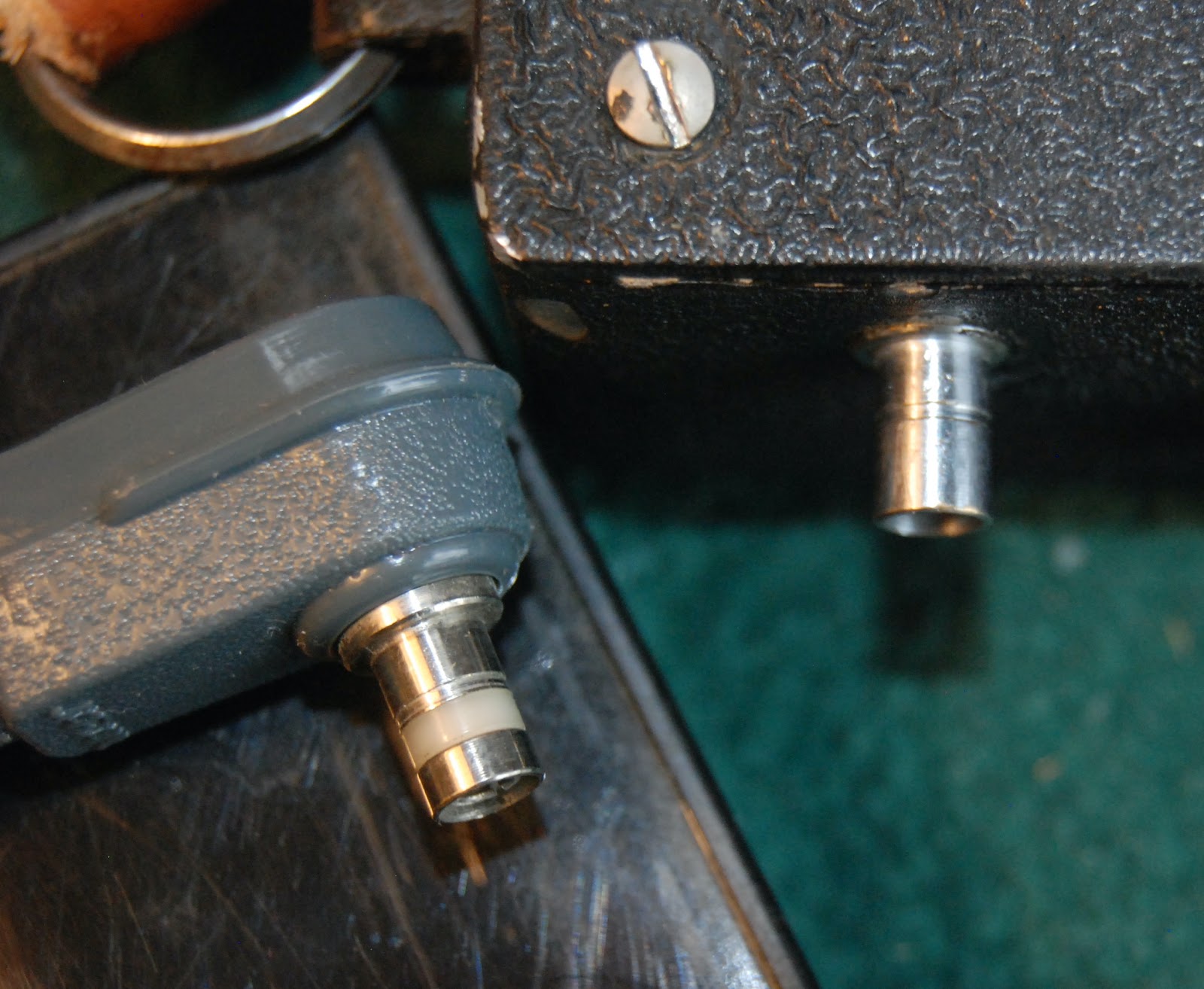
The two types of motor plugs. This motor uses the two-wire type on right.

The operation of the type one motors is quite different from the later types—which are three-core, three-wire and closely resemble the F36 motor for the Nikon F. A close look at the plugs for the type one (two wire) and the later three wire plugs shows one difference. The hot wire inside pin is the same as later plugs, but the three wire metal sheath has two parts: one closes the circuit for continuous firing, the other allows single frames from a battery pack. With only a two wire connector, a remote triggering on this type one only allows continuous firing. Single firing is also different. Set the knob on the back of the motor to the white dot and the camera fires when one uses the standard release on top of the camera. Lift the finger and the motor advances to the next frame. The dot setting is also for continuous shooting when the button set in the knob is held down.. Set the knob to K (for 継続的な [Keizoku-tekina]—the Japanese word for continuous) and the motor will fire the camera by itself until the counter winds down or the film runs out. The K setting is also for continuous shooting when the battery pack is set for remote. Note: The K mark changed to ‘C’ after about the first 200 motors.
The unique battery pack

Back of camera fitted with motor & battery pack
NOTE: Copies of the original instructions are downloadable from Pacific Rim Camera’s web site. This particular motor is as worn as the camera with equal evidence of hard usage. Despite rust in spots on screws and the blade springs for the pressure plate, the interior was clean and the motor does fire from the cordless battery pack.

The Cordless battery pack: This pack appears to have been designed specifically for this motor and is probably one-of-a-kind. No serial number or any name on it. It is similar to the Jacobson cordless packs built for the rangefinder Nikons and the Nikon Fs, but differs in many details. A front-mounted  release allows remote operation in a continuous mode—or single shots if your finger is
quick enough.

The open battery pack before modification and after for use with 9 volt battery

A mini-phone jack on the side allows for remote firing via a cord with a switch. The battery pack adds only 3/8th of an inch (8mm) to the overall height. Most of the pack is in front of the motor. That part is 2.5 inches deep (65mm). The front rises 1 3/8 inches (35mm) in front, and overall width is 5.5 inches (140mm). The wide bottom provides a stable base and the camera will not tip over. It offers two quarter-inch tripod bushes. one centered and a second to the right which appears to have never been used. Three small screws hold its lid in place. Remove the top and there is a place for seven AA flat-top, nickel-cadmium rechargeable batteries. Seven? Yes. Flat tops yield less power than standard AAs, so seven were needed to bring the power up to the nine volts the motor needed. The original batteries are long gone and the contacts corroded, but the combination hints at the age for the pack since Nic-cad batteries did not become readily available until 1960. My local battery store soldered in a connector for a standard 9 volt battery and it works! But a single 9 volt battery has little humph and the motor runs slowly. I’m lucky to get two rolls of film through the motor before the voltage drops too low for the motor to complete a cycle. Oh, well. What can one expect after sixty-five years? We’re all slower than we used to be. I’m just happy it works at all. 

The 21mm f4.5 Zeiss Biogon lens that came with camera

The 2.1cm f4.5 Zeiss Biogon lens: The camera came with this lens and its presence indicates what the original owner eventually used the camera for. With the cordless pack, this would have been an ideal combination for a newspaper photographer to grab “Hail Mary” shots by raising the camera high, pointing in the general direction of a speaking politician or a crowded event and pressing the release again and again. This super wide-angle would have made certain that he or she would have gotten a few usable shots in focus. In the early 1950s, Zeiss Ikon called its great lens designer, Ludwig Bertele, back from Wild in Switzerland and commissioned him to design one last lens: the 21mm Biogon. When Zeiss brought it out in 1954, it was the widest lens for any 35mm camera anywhere in the world. The Contax version fits a Nikon rangefinder camera and even couples to the rangefinder—although why anyone would ever try to focus it is a good question since even wide open, focus is from infinity to 4.5 feet. It was the inspiration for the 21mm f4 Nikkor-O that would be NK’s widest 35mm lens for many years.

The camera’s history: The camera and motor kit came from an ebay seller in Hillsboro, Oregon—a suburb of Portland. Other than that, we have not been able to discover its history.
Number 063 on interior of faceplate is either evidence of a past repair or a company production number

The west coast of the United States was a leader in the use of Japanese cameras in America and it is possible—even likely—that this combo was purchased for a staff photographer working for either the Portland Oregonian or Portland Journal—Portland’s two daily newspapers—in late 1957 or early 1958, or as soon as that camera-motor combination became available. The Portland Journal would die in the 1960s after a long, bitter labor strike, and if that is where the camera was owned, its use might have died with the newspaper. This may be one of the first Nikon SPs sold in Oregon. If anyone has any ideas as to who its owner might have been, I would certainly welcome that information. Whoever owned the camera must have grown concerned over the brassing of the black paint because at some point he or she carefully covered all the exposed edges and much of the camera surface with 3M’s “decorate and repair” tape. This type of tape can do an excellent job of protecting metal and painted surfaces provided it is not left on too long. I have used this kind of tape on other cameras in the past and it works well, but left to cold, dampness or heat, the adhesive can harden, making removal without damaging the paint underneath almost impossible. On this camera, the tape had become ugly and was peeling in places. Careful removal resulted in some loss of paint, including most of the serial number (no, I’m not the one who did that peeling). However, the number is still readable under magnification.

Dead hemlock taken with 21mm Biogon

Camera set up for use. Handles nicely.

Monday, July 25, 2022

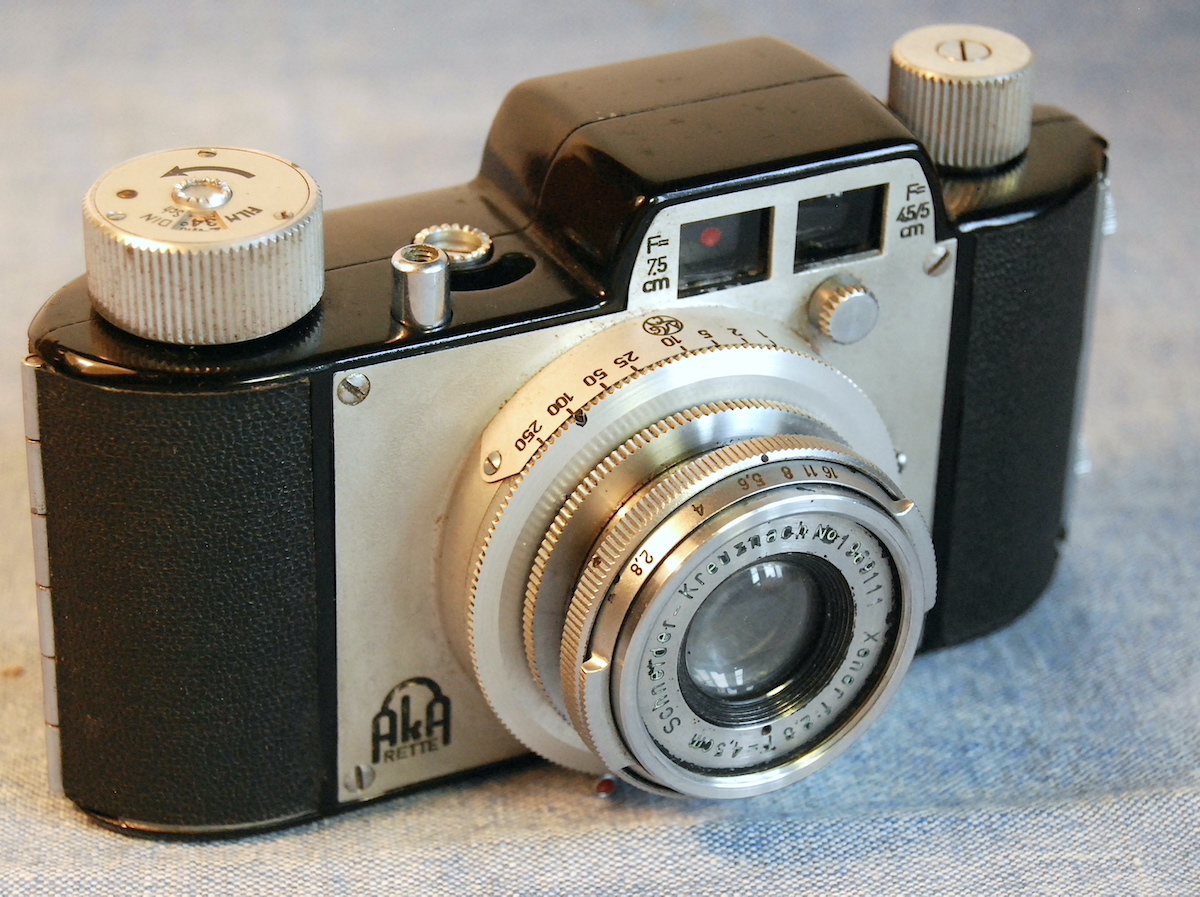
Akarette 1 from 1947

Akarette 1 from 1947 with 45mm Xenar

In an earlier post, I covered a general history of the Akarette/Akarelle cameras made by the German company of Apparate und Kamerabau GmbH. <http://wesloderandnikon.blogspot.com/2021/05/akas-akarette-and-akarelle-compact-35mm.html> Here I want to point out some features of the earliest Akarettes as well as display the range of quality Schneider lenses AkA offered for the camera at one time.
  
Akarette with 7.5cm f3.8 Tele-Xenar. Finder covers both focal lengths.

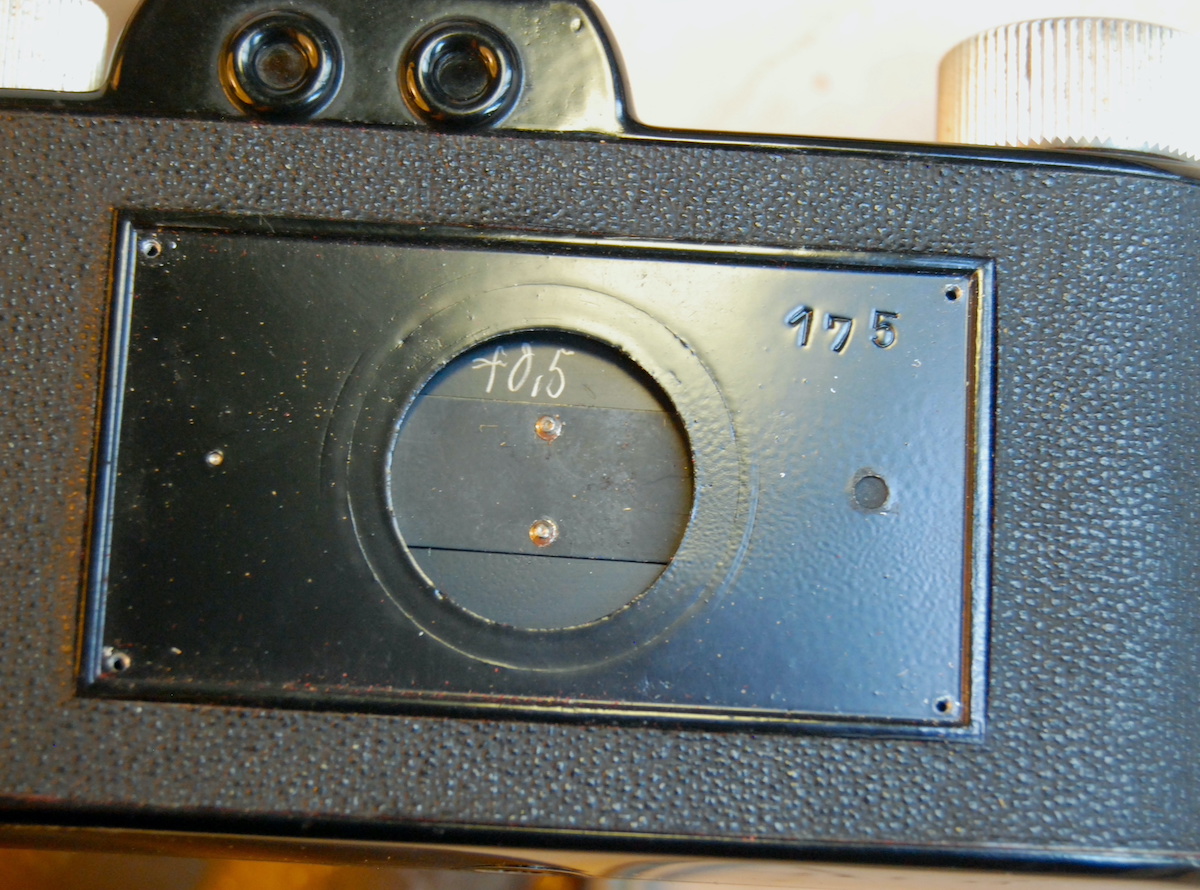
 This is an Akarette I. Serial number is 175, which would date it to early 1947—among the first cameras the company produced while still operating out of a hotel room in Wildbad in the Black Forest of southwest Germany. The earliest Akarettes used the 24x32 format—the same as the first Nikons and several other early Japanese 35mm cameras. However, despite its low number, this particular Akarette is in the 24x36 format. Fine with me. Easier to get slide film processed and mounted. Was it always 24x36? Was it modified later? Counter runs to 40 and the standard lens it came with a shorter 45mm, so who knows?
  
Serial number behind back chart plate.

 Serial numbers on early Akarettes are hard to find. The camera body consists of two cast aluminum shells with the back shell overlapping the front shell around the edges to make a nice light-tight body. The serial number is stamped on both shells. On the back it is located under the back plate chart with its wide range of exposure factors. You need to remove the chart to find the number. The number for the front shell is inside—behind the shutter/finder module You need to remove the module to see it. Why AkA hid the numbers this way is a question I cannot answer.
Serial # behind shutter module in front casting.


    Although the finish is a bit crude, in some ways it has held up better than the later Akarette II and Akarelles. No chromed top or bottom plates. Instead, the castings are directly finished in a glossy, hard, black enamel. The front plate is polished aluminum. Not pretty, but in better condition than the nickel-finished brass plates on later models that almost always show brassing. Shutter is an early Prontor with the Gauthier mark on top. Speeds from 1/250th down to one second plus B. A respectable shutter for 1947, and probably the best that Gauthier offered at that time. Frame counter is easy to see, which is more than I can say about later models.
The dual finder is clear and the rotation between 45/50 to 75 easy. I just wish it had an accessory shoe so I could mount a finder for the 35mm f3.5 Xenagon wide angle.
Sadly, the original lens for this camera is dirty, stiff and hazy. It is unusable without major surgery. It is also uncoated and most of the black paint is missing from the beauty ring. Still, I like the camera’s compactness and easy to use controls. If one can get used to zone-focusing and mounted a lens in better condition, this could be an easy camera to put in a coat pocket and head out to take pictures.

Snowdrops, 45mm Xenar

South view, 35mm Xenagon

Linda splitting wood. 45mm Xenar


Full range of Schneider lenses for the Akarette. 3.5cm Xenagon, 4.5cm Xenar, 5cm Xenon, 7.5cm Tele-Xenar, 9cm Tele-Xenar

AkA was determined to offer a camera with a full range of accessories and optics. All of the first lenses came from Schneider, an optical company capable of producing first-rate lenses. Here is a picture of the various Schneider lenses initially offered in the Akarette mount. Except for the 90mm lens, all are compact, solid, unit-focusing lenses. The 90mm f3.5 Tele-Xenar isn’t really that big, but compared to the other lenses, it’s a monster, twice the size and twice the weight of the 75 and with its focus direction the opposite of the others, it feels out-of-place.
    Later lenses included front-element Xenars and optics from ISCO and other cheaper sources.


Sunday, January 9, 2022

German 90s and 135s from the 1950s

Why were the German 35mm rangefinder camera manufacturers so wedded to the 90mm focal length? Was it because Leitz led the way with its 90mm f4 Elmar? Was it an easy focal length to fit on a mount with a behind-the-lens leaf shutter? Perhaps part of the understanding as to why the German 35mm camera industry largely failed in the late 1950s can be seen in this picture of a range of various 90mm lenses and a equivalent 85mm f2 Nikkor-P from the same period. The five lenses here are arranged by size. The smallest is a 90mm f4 Color-Telinear with a close focusing distance of 1.8 meters (6 feet). Distance is marked in both feet and meters, the body is mostly aluminum with chromed brass at the wear points. It is a nicely-made lens but a close focus of only six feet a loser and the maximum aperture hardly inspiring. Next is a 90mm f3.5 Tele-Xenar made by Schneider for the Akarette/Akarelle. Beautiful construction in heavy chrome-over Brass. Focuses down to one meter (39 inches). Again, nice lens but tiny controls are hard to read even in good light and small maximum aperture makes available light photography challenging. To the right of the black-finished Nikkor is a 90mm f4 Schacht-Travenar for the Leidolf Lordomat. Relatively light weight with a largely aluminum barrel and focuses down to one meter. Again, a nicely-finished lens but the small maximum aperture limits dim-light shooting. Finally we have a Leitz 90mm f2.8 Elmarit from the 1960s. A long-focus design instead of a a telephoto, it is notcably longer and larger. A flexible design but being Leitz, expensive. Now compare these optics with the 85mm f2 Nikkor-P in mount for the Nikon rangefinder cameras. It focuses down to 3.5 feet (sligtly over a meter), but with a maximum aperture of f2, it puts all the other lenses to shame by at least one full f-stop. Only the Zeiss 85mm Sonnar matched that. So what was happening? Japanese companies like Nippon Kogaku (Nikon) and Canon were selling lenses that were lighter, faster and generally closer focusing than the German equivalents. Customers were looking for those features and finding it in Japanese products at competitive prices. Part of the problem was that, except for the Leitz lens, all these optics were made to fit in front of a behind-the-length shutter which allowed only small rear optics in order to clear the shutter opening without vignetting. As long as the German companies were limited in what shutters they could use due to patent restrictions and Zeiss Ikon's promotion of Compur and Prontor shutters, customers could only buy slow speed optics.
The same holds true for the 135mm lenses these same companies sold. Here are three 135mm and one 130 lens from late 1950s and mid-1960s. The Schacht-Travenar and the Tele-Elmar, both f4 lenses, are similar in size to the 135mm Nikkor-Q f3.5 lens. All have similar close-focusing capabilities. But look at the Agfa 130mm f4 Color-Telinear with its huge 62mm filter front. Again, a need to compensate for a small exit pupil led to a big front and a no-where-near close focus of three meters!

Saturday, January 8, 2022

The Lordomat standard [Primus], an interchangeable-lens 35mm camera from the 1950s


Lordomat standard types 2 and 3 with 50mm f2.8 and 50mm f1.9

History: The Leidolf company was founded in 1921 by Rudolf Leidolf in Wetzlar, Germany. Leidolf had trained as a “precision mechanic” at Henson & Son. He was later joined by his son-in-law, Fritz Meinhardt, who had also trained as a precision mechanic for E. Leitz. The company started business machining parts for microscopes for Leitz. Meinhardt would in time take over management of the company and he may have been responsible for many of the camera designs.

    Leidolf got into manufacturing cameras after World War II (starting in 1948-49) along with many other optical firms trying to take advantage of the high post-war demand for German cameras. Its first camera were a simple, metal-bodied cameras called a Leidox that used 127 size film. Leitz did not like that name and under threat, Leidolf changed the name to Lordox. Following popular trends, the company turned to a 35mm version in 1952.
  
Notice of Lordomat sold by Widina, 1953.


  In 1953, Leidolf announced a new 35mm camera with a behind-the-lens Gauthier Prontor shutter and offering complete interchangeability of lenses. This became the Lordomat “standard.” It was supplemented by the more sophisticated Lordomat C35(luxus) with an additional finder and a built-in meter in 1956. Leidolf would later produce many different versions of their camera that would use the same basic body-shape, layout and controls. Some, such as later Lordox, had non-interchangeable lenses. Other versions included built-in light meters and bright-frame finders. The company ceased camera production in 1962 but lingered on as a part of Wild Heerbrugg before disappearing into the Leitz Holding company in 1990.

* For a through review and many images of the different models, I recommend Cees-Jan de Hoog’s website <http://www.cjs-classic-cameras.co.uk/leidolf/leidolf.html> Mike Eckman also has an excellent review of a Lordomat in his series on older cameras <https://www.mikeeckman.com/2015/11/leidolf-lordomat-1953/>. For a detailed and accurate history of the Leidolf company. I recommend the December 15th, 1998 issue of Photographica Cabinett which is totally devoted to a history of the Leidolf company and its cameras.

    Leidolf does not appear to have ever manufactured anything for their cameras other than the bodies—with the possible exception of their 35mm finder. Other accessories came from Wedena in Bad Nauheim.
    Wedena was a marketing firm founded by Willi Diehl. Originally a company called “Widina” for Willi Diehl Nauheim, it served as the exclusive sales department and marketer for the Leidolf cameras. All the German advertising and even the camera instructions identify Wedena as the company responsible for the Leidolf cameras. Wedena also marketed other photographic products such as the Taco Universal flashgun which was actually manufactured by Erich Kaiser. The Lordomat’s turret finder, filters and closeup lenses all bore only the Wedena name.
    Wedena based its sales strategy on getting major mail-order and photo supply companies to sell the Leidolf products instead of working to get the Lordomats into specialty stores. Starting in 1957, most of the German sales were made through Foto-Quelle, part of a huge warehouse-catalogue-sales chain that in 1970 would claim to be “The largest retailer in the world.”

Quelle ad for C35
      The Leidolf camera sold throughout Europe, including England, but breaking into the critical North American market proved more difficult. Initially several small, New York based firms picked up the franchise, but none appear to have lasted long. In March 1955 the Minifilm Corp is listed as selling the Lordomat. By September 1956, Royal Photo Distributors are the “Sole Agent.” By May, 1957, Camera Import Corp. was handling sales. In 1958. Montgomery Ward was claiming “Exclusive import rights and sales” for the Lordomat. To do this, the major catalogue company added less expensive versions of the Lordomat with an “Adams” label. In 1959, importation would shift to Unimark Photo, Inc. which added its name to the cameras.
    This outsourcing of marketing and dependence on catalogue sales was to prove fatal. With Japanese camera sales growing in the United States and a shift in public demand to single-lens reflexes, companies like Wards and Foto-Quelle insisted on lower and lower prices in order to maintain sales. By 1962, margins had narrowed to the point that Leidolf could no longer make money. When Meinhardt, now the company’s president, refused Foto-Quelle’s latest demands, Foto-Quelle cancelled the contract and, with no German market, Leidolf stopped manufacturing cameras and most of the workers were let go.  Rudolf Leidolf and Fritz Meinhardt both died in 1964.

Cover for Wedena & Royal Photo Importers
   All of the Lordomat’s lenses came from two small optical firms: Enna Werk in Munich and Albert Schacht in Ulm. Both companies manufactured a wide range of lenses in a variety of focal lengths and in a various mounts, particularly in the M39 and M42 thread and in the Exakta mount.
    Enna supplied the Lordomat’s normal lenses, either a 50mm f2.8 Lordonar or a 50mm f1.9 Lordon. It also made a 35mm f3.5 Lordonar and a 90mm f5.5 Telordon plus others. Schacht made a 35mm f3.5 Travenar/Travetar, a 90mm f4 Travenar and a 135mm f4 Travenar. Except for the Lordon, all were four-element optics.
    A three-element 50mm f2.8mm Triplon in the Lordomat mount was sold with the cheaper Adams camera and also appeared on the non-interchangeable Lordox and other Leidolf cameras.

    The Lordomat standard came in three versions. All three featured a Prontor SVS shutter with speeds to 1/300th of a second and included a self-timer. The first shutter type used the old progression of speeds and did not have click stops. Later versions use the modern speed progression, have click stops and feature a button that needs to be depressed to shift the flash sync/self-timer setting.

    The first version of the camera has an orange-red film over the rangefinder window. It is the least common version. It also came with a smaller 50mm f2.8 with a chrome front and taking a 34mm filter size. By 1955, the red filter for the rangefinder window was gone and a larger normal lens taking 40.5mm filters was standard. In the third version, strap lugs were added. Otherwise, all three versions are alike.
    The first impression one gets is that this a simple, compact camera with clean lines. The wide-based rangefinder and the symmetry of the front with its centered lens mount and equal-sized windows give it balance and helps the handling. The clean top—with all controls except the counter/rewind knob set into the surface—is attractive. The viewfinder is a simple optical finder but bright and clear. No parallax correction. The rangefinder patch in the ones I have seen is bright with a yellowish tinge. The double stroke, reverse wind advance lever is different but easy to get used to. The back comes off with a turn of a bottom lock. Tripod socket and accessory shoe are both centered. Lenses exchange via a threaded collar that fits over a male thread on the body. A notch and pin allow alignment. A simple design similar to the mountings also used by the Akarette/Akarelle and the Diax cameras.

The Lordomat lens mount.
      Film loads with a reverse curl, but I find the slot on the take up spool difficult to work with and don’t trust the film is advancing correctly until I have observed the rewind turn with an advance. The film counter sets below a plastic-covered window. In almost all cases, the plastic has turned yellow, even a dark orange, making the frame numbers difficult to read.
    Removing the top requires only a set of screwdrivers and a spanner wrench. Be careful. A tiny bead acts as a click stop for the film reminder built into the rewind knob. The socket for the rewind may contain tiny brass shims. Two of the Lordomats I handled have their rangefinders off vertically. There is a way to adjust, but it is not easy. The weakest part of the camera is probably the return for the film advance. A wire loop attaches to the capstan and, in turn, connects to a spring that extends half the width of the camera’s top interior. If the wire breaks, the advance lever has to be manually pushed back to the front. I fixed this using 10 lb. monofilament fish line with super-glued knotted loops at each end. Seems to be working for now.

    German leaf shutters, Compur or Prontor, all seem to have problems with sticking and slow speeds getting too slow. The Lordomat shares this problem. Exercise and application of lighter fluid seems to help, but keep shutter the blades clean. Focus and aperture rings on my normals and wide angles all seem to be fine, particularly the 50s which still turn smooth as silk. The Schacht telephotos I own had stiff focus and in two cases were completely frozen. Hair dryer heat and lighter fluid got them working again, but focus remains rough.

    Final observations: This a camera I find a pleasure to shoot with. The low profile, compact size and easily-set controls are strong points. Despite an all-metal construction, the camera does not feel too heavy. Lens controls are easy to set and on the 90 and 50mm f2.8, f-stops click into place with precision. All but the early Lordonars take readily-available 40.5mm filters and hoods. In tests, I particularly like the 50mm Lordonar and the 50mm Lordon. Schacht lenses have a mixed reputation, but the 35mm Travetar performs well. I am not impressed with the 135mm Travenar.

    Because it was imported into the United States, Lordomats show up in this country on ebay regularly, but prices tend to run higher than my budget will allow. These are good cameras and both users and collectors like them. The accessory lenses are harder to find and finding ones in usable condition may be difficult. If you are looking for a easy-to-use 1950s rangefinder 35, you might want to consider a Lordomat.

Two 35mm lenses, Travenar & Travetar with cases


90mm f4 Travenar with finder

A bevy of lenses, except the 50mm, all from A. Schacht

Interior 50mm Lordonar

Interior with seamstress. 50mm Lordonar

White oak and beech

Wood must be split. 35mm Travetar

Child's castle. 50mm Lordonar
Wineberry canes at dusk. 35mm Travetar


Masonry heater. 50mm Lordonar