Friday, May 10, 2019

Schneider lens for Agfa's Ambi Silette camera

A Color Ambion 35mm lens and the 35mm Curtagon for the Ambi Silette
The Ambi Silette 35mm camera was Agfa’s most ambitious rangefinder camera featuring fully-interchangeable lenses, a large, beautiful rangefinder-viewfinder with auto-compensating bright frames and a Synchro-Compur shutter with speeds from one second to 1/500th. However, Agfa never offered more than four focal lengths and the fastest was the 50mm f2.8 Color Solinear. The only wide angle was a modest 35mm f4 Color Ambion barely focusing down to a meter.
    So where did this Schneider 35mm f2.8 Curtagon come from? It certainly did not start life as a Ambi Silette lens, but it mounts, focuses and changes f-stops flawlessly. Alas, no rangefinder coupling, but being a wide angle should allow a calculated guess to provide correct focus most of the time.    The front end back to the aperture control is finished in a brushed chrome. In appearance it matches that of the Curtagons made for the Retina Reflex from the time period that the Ambi Silette was on the market. The word Compur engraved on the focusing ring would tend to confirm this.
    The Aperture ring and the Ambi mount are a brighter chrome and made from a heavier stock, either chromed brass or stainless steel.    At first one might guess that this is someone’s custom job run off on a lathe. But if so, why does the rim of the aperture ring sport a marking “Agfa – Typ 44017/100?”
    Underneath the focusing ring is an engraved image of a flashbulb that acts as marker for a range of f-stops. Is this a flash guide? If so, for what type of bulb?
    No filter threads, but 40.5mm slip-on accessories fit. It focuses down to two feet. It does not appear to vignette. So, here is a close-focusing, faster lens that uses a more modern five or six element retrofocus design. So why did Agfa stick to the slow, Tessar-based Ambion?
    Who knows? But I intend to enjoy this lens and find out what it is capable of producing.

Looks like a Retina Reflex lens
The Agfa marking on aperture control ring.
Ambi Silette clamp mount.
Flash guide marking on bottom of focus ring.

Lens' beauty ring.


Wednesday, September 5, 2018

My Super Ikonta A

 The Super Ikonta A, Zeiss Ikonta's smallest 120 film folder.


The Super Ikonta as it appeared in ebay
Sometimes my photographic investigations wander slightly afield from my focus on Nikon and Tenax cameras. Here we have a Zeiss Ikon Super Ikonta A (Bestell #530) from the mid-1930s. It is of the second type with the shutter release moved onto the body, but before the addition of lots of chrome that marked the 531 versions.

It is equipped with a 7cm f3.5 Tessar in a Compur shutter. At the time it was sold, this was the top of the line in 4.5X6cm 120 size roll film cameras. The rangefinder uses a rotating wedge mechanism coupled to the front element of the lens. These cameras were not cheap and even today Super Ikontas in good condition generally sell for well over $100 on ebay.

The 4.5 X 6cm format has a certain appeal to me. Large enough to be medium format, but still small enough to allow compact lenses and a compact camera body. The extra frames on a roll of 120 film is a nice plus.
    So when I spotted this Super Ikonta A on ebay for only $50.00 (US) I took note. As you can see in the first picture, the condition was not promising, but I decided to take a chance and bought it.
    Several hours of labor using saddle soap, leather restorer, a soft toothbrush, toothpicks, Q-tips, lens cleaner, lens tissue and soft cloths and I had what you see here. Oddly enough, it came with two 620 spools, which I promptly sold on ebay.

    Bellows is still light-tight. Shutter is reasonably accurate, lens is clear. Everything as
works as well, except the frames of the albada finder are badly faded and the rangefinder is dim. Still a great picture taker. And results? Nice, sharp pictures with plenty of contrast and depth.
Quechee Gorge, Vermont
Scott and Charlotte at Quechee Gorge

Friday, May 11, 2018

Zeiss' 50cm f8 Fernobjektiv

The longest lens that Carl Zeiss in Jena manufactured for 35mm cameras was a 500mm f8 lens it referred as a "Fernobjektiv" or Far lens. Part of the text below first appeared in an article I wrote for the 2014 Spring/fall issue of Zeiss Historica [Vol 36, no.1]
50cm f8 Fernobjektiv on a postwar Panflex and a Nikon SP.

In the late 1940s, as Zeiss was trying to figure out what company it still was and what market it should aim for, the Jena factory completed a run of 40 Fernobjektivs, supposedly all in the post-war Flektoskop mount (#s 3412641—3412680, order #907, 8 August to 15 November, 1948). When the Jena facilities finally got around to some kind of regular production, new Fernobjektivs came out in mounts for the East German Zeiss Flektometer housing or with adapters for Exakta or in the M42 thread. Production continued into the early 1960s.

This Fernobjektiv uses the external bayonet mount. It works equally well on a BR-1 ring.
So how did the 50cm Fernobjektiv pictured here end up in the Panflex mount? The serial number  (#3412655) is within the same 1948 batch that were supposed to be in Flektoskop mount. So it must have been intended for the pre-war Panflex. Were a few of that batch made and sold in the Panflex mounting?

The lens itself is a single component achromat doublet in a long-focus design. Such a simple design is capable of excellent sharpness and contrast particularly in the center of its field—provided the lens is confined to a modest aperture and narrow coverage. The famous long-focus lenses offered by Novoflex use a similar optical design. The finish of this particular lens is good if not spectacular. A nice modern black crinkle finish was applied over a smooth black coating with the exception of the diaphragm and focus rings. The glass is T-coated. It takes readily-available 77mm accessories. Apertures close down to f45 with a manually-controlled iris mounted nearly 16cm (seven inches) behind the glass. The focusing helicoid is set forward and just behind the glass. The lens focuses as close as six meters (19.1 feet) with a nearly 360 degree turn of the focus ring. Only the glass moves; the diaphragm remains stationary.

Mounted on a Panflex with a Contax or Nikon rangefinder camera attached, the lens balances on its rotatable tripod bushing. Weighting only 1.627 kilos (4.5 pounds), the lens should be handholdable. However, the focusing ring is set so far forward and has such a long turning that focusing while trying to hold a camera steady becomes an exercise in frustration. This is particularly true if one is trying to follow a moving object.


Using a BR-1 ring, this lens mounts on any F mount Nikon, requiring on a slight shift of the focus to bring infinity into sharpness.
Like all lenses with focal lengths longer than 250mm, the Fernibjektiv vignettes on a reflex housing. This is due to the small throat of the Contax/Nikon bayonet system.
On a Panflex, the Fernobjektiv vignettes.

However, on a Nikon F, it does just fine and is capable of nice, sharp results.


Immature female Coopers Hawk Accipiter cooperii at our birdfeeder. It did not come for the seeds.

Tuesday, January 23, 2018

Mountain photography

Someone asked what are the best lenses to use for mountain photography. My answer: any focal length you want. Here are a set of examples taken the summer of 1972. Linda and I hiked to the summit of Sheep Mountain in the Gros Ventre Range of Northwestern Wyomissing.
All taken with Kodachrome.
Linda and myself on the summit of Sheep Mountain. Nikon SP and 28mm W-Nikkor. Note Nikon F in my lap.


Jackson Hole looking Northwest from Sheep Mountain. The Teton Range across the valley. Nikon SP 28mm W-Nikkor.

Middle Teton, Grand Teton and Mount Owen from Sheep Mountain. Same view as 28mm W-Nikkor but using 400mm Tele-Nikkor on Nikon F.


Monday, September 25, 2017

Searching for the Tenax III

Page 1 of a British patent application from 1936
It has been known since the 1980s that Zeiss Ikon intended to produce a Tenax III with a built-in meter similar in principle to the Contax III.

Larry Gubas’ presentation of a patent drawing on Facebook for a light meter contained within a camera body is evidence of the changes Zeiss Ikon was considering for its various 35mm cameras. What I find interesting is that the camera type that appears in the drawings is definitely a Tenax of the Tenax II type, and not a Contax. This suggests that Zeiss Ikon intended to build the same metering system into both its Contax and its Tenax.

The evidence in the drawings: the proportions of the body, the placement of the rangefinder windows and the square viewfinder window are all pure Tenax. The shape of the lens and placement of shutter and focus levers are also Tenax. There is no way that this camera could be a Contax. But what about the famous plunger advance? The placement of the proposed meter window is certainly in the way.

For some time, a Tenax II protoype has been known in which the plunger  advance has been replaced by a horizontal lever that projects from under the frame counter. It was once thought to be a prototype for the military, but with the understanding that a meter window on a Tenax III would require the repositioning of the film advance, this camera becomes evidence of how Zeiss Ikon might have solved the problem of a lever blocking a meter window. This patent drawing also is the first evidence I have seen as to what the Tenax III might have looked like had it been manufactured. While the advance would have had to be relocated, the height of the camera (and therefore, the accessories needed) would have remained the same. The camera would have remained compact and fast operation and ease-of-use would have been unaffected.
The Tenax II prototype. Picture courtesy of S. Baumgartner


The Contax IV itself exists as a several drawings plus a number of incomplete prototypes which Gubas has shared in his book and on line. It was to be a revolutionary rather than an evolutionary product retaining only Heinz Küppenbender's vertical shutter and the external bayonet of the Contax II and III. Why?

The answer lies in patents, corporate politics and the limitations of 1930s technology. The Contax’s vertical shutter was complex and took a lot of space “under-the-hood.” Yet Küppenbender considered it his masterpiece and would not allow its abandonment. What little room was left inside was taken up by the complex internal/external lens mounting system with its built-in focusing mount, gears, sliding focusing prism and the huge bar prism that ran the width of a Contax. To maintain all this, Hubert Nerwin and his design team had to place the meter outside and on top on the Contax III. While a workable solution, it raised the height of the camera and added bulk and weight to a camera already heavier than its Leica competition. It also meant that any finders and other accessories would no longer line up in the same way as ones for the shorter Contax II. This is why there was a separate Contameter  (1340) for the Contax III, as well as different masks for 85 and 135mm lenses.

The Contax IV was an attempt to solve all these problems in one complete redesign. By eliminating the built-in rangefinder system and the internal lens focusing mount, Nerwin was able to gain enough room to move the meter inside the camera, eliminating the meter hump and duplication of accessories. This also meant that all lenses would use the same mount and handle in the same way—a design imperative for Nerwin. The focusing lever and external rotating prism system that the Contax IV advocated was the same as used on the Nettax and had already proved itself on the Super Ikonta series of cameras. It promised the same focusing accuracy as the Contax, but allowed faster focusing via a lever instead of a slow-turning wheel. By continuing the use of the external bayonet mount, all external accessories would remain the same, and legacy lenses would still mount, although focusing would be by guess.

The placement of the meter window below the film advance may seem a bit strange, but it was to be in the camera but away from the rangefinder window. The left hand would now be doing the focusing for all lenses—the same as the Nettax and the Tenax II—and the right hand would remain on top of the camera for winding and shooting. All-in-all, a workable design for both the Contax and the Tenax that would fit into Nerwin’s design priorities for ergonomics and simple, intuitive handling.


Sunday, July 2, 2017

The 2.7cm f4.5 Orthometar, Zeiss Ikon's rare wide angle for the Tenax II

The 2.7cm Orthometar lens for the Tenax II. Note that this particular lens is marked in feet. It dates to October 1937, part of a patch of 100 built before the Tenax II camera was released for sale in April 1938.

Hubert Nerwin designed Zeiss Ikon's Tenax II camera of 1937 as a fast-action rangefinder camera with fully interchangeable lenses. That meant its lens offerings had to include at least one wide angle. This proved to be a bit of a challenge. There were few options in wide-angle designs in the 1930s. Initially the Contax had made do with a slow 2.8cm f8 Tessar that did not even couple to the rangefinder. The later fast and sharp 3.5cm f2.8 Biogon was the best wide-angle that any lens manufacturer could offer at that time, but its depth precluded its use on the Tenax. So Nerwin chose  an Orthometar design.
    The Orthometar was designed as an aerial lens by Dr. Robert Richter. As its name implies, it was particularly free of distortion—an important consideration in a lens used for aerial mapping. A modified double Gauss design, it appears similar to the 28mm f3.5 W-Nikkor for the Nikon RF cameras except for a much smaller back element.
    Zeiss also took the design and used it in a 3.5cm f4.5 lens for the Contax cameras—slower than the Biogon, but priced at a lower price point than the Biogon.
   Adapted for use on a 24X24 format camera, such  as the Tenax II, the 27mm focal length yields the same angle of view as a 34mm lens on a 24X36mm camera.

    Although it takes the same 34.5mm screw-in filters as the other lenses for the Tenax, the Orthometar optics are small, a mere 6mm across the front. Grinding the inner elements must have been a difficult and challenging task. The five aperture blades are also tiny. The spaces between aperture markings are even and the aperture closes down to f32. The barrel does not rotate when focused. This is a modern lens lacking only clickstops to make it comparable to any RF lens made today. It focuses down to less than three feet with a 30 degree swing of its under lens focusing lever.

Carl Zeiss made only three lots of this lens: two prototypes in 1937 (nos 2025791 and 2025792), then a production run of 100 finished on October 1st, 1937 (nos.2203301-2203400). A final run of 200  probably came close to a year later (nos 2360001-2360200). The lens was expensive ($132 dollars, or equivalent to over $2200 at 2017 rates) and the market for wide-angles limited. The outbreak of World War II less than a year-and-a-half after the camera’s introduction undoubtedly contributed to the low numbers and small sales.

With such a small production, it is a wonder that this lens is available at all, but I snagged the one illustrated here off ebay with a buy-right-now option complete with its finder and a Tenax camera and custom case. Unfortunately, the camera had been dropped, but with parts on hand I have been able to get everything back in working order.

The lens is easy to use and the results sharp. I like its compactness and easy to set controls.
More details on the Orthometar for the Tenax can be found in my book on the Tenax II, available from Blurb Books:
http://www.blurb.com/b/8032913-the-tenax-ii-zeiss-ikon-s-precision-fast-action-ca
Orthometar mounted on its original Tenax with finder 482/6

Orthometar images


The Tenax II: Zeiss Ikon's Precision Fast-action Camera


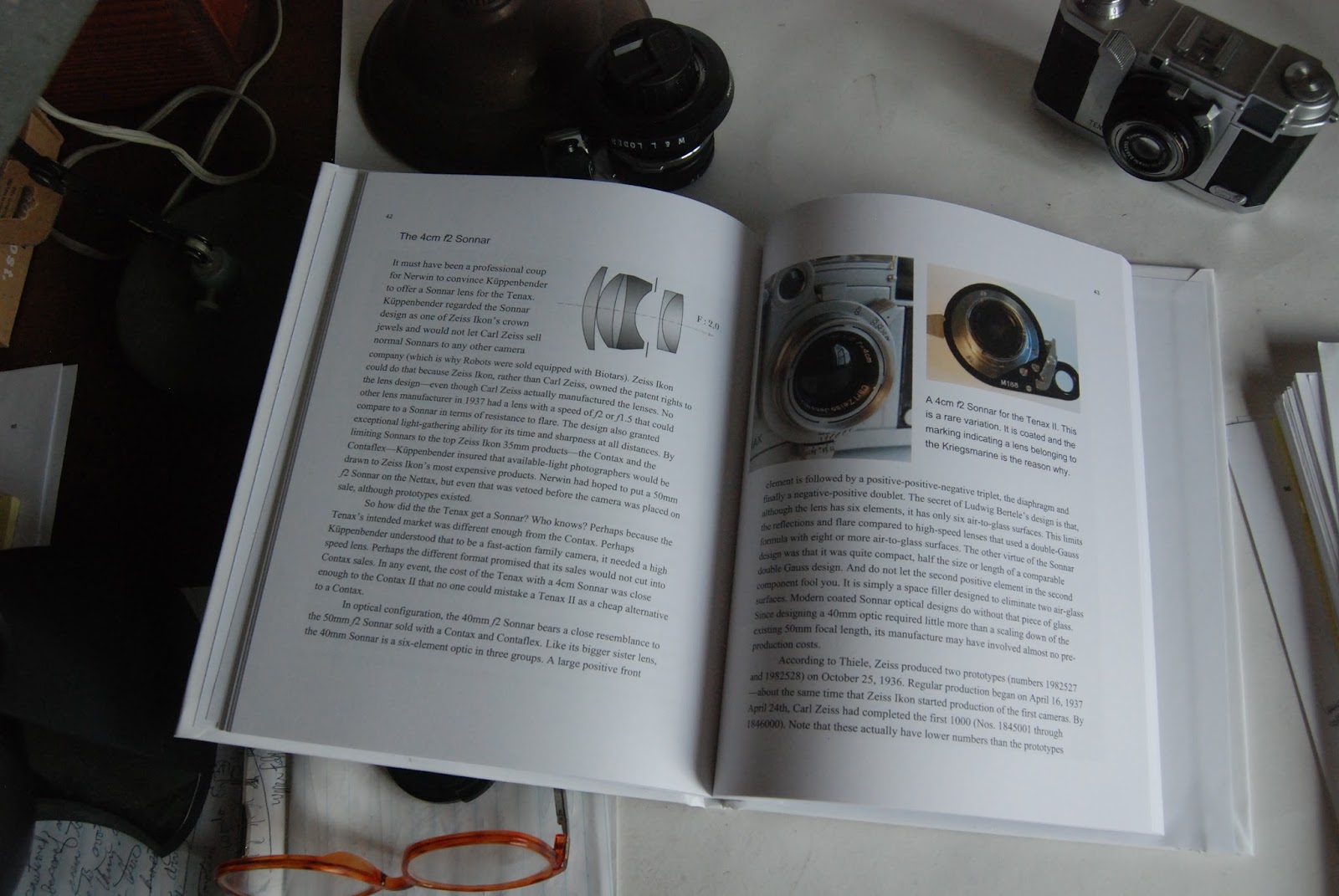
I recently put the finishing touches on my book on Zeiss Ikon’s Tenax II camera.

As followers of this blog know, I have been enamored of the Tenax II camera for some time. Having put a great deal of my time into researching the history of the Nikon rangefinder cameras, I decided to branch out a little and investigate one of Zeiss Ikon’s premier cameras in the period immediately before World War II.

I have now published a short book on this unique camera. It is

The Tenax II: Zeiss Ikon’s Precision, Fast-action Camera: A Pictorial Compendium and Gallery of Work.

It is available from Blurb books. Price: $38.49. 104 pages with over 100 full-color illustrations that combine detailed pictures of the camera and its accessories with historic advertisements and my own pictures taken with a Tenax and its lenses.
Go to:

http://www.blurb.com/bookstore/detail/8032913-the-tenax-ii-zeiss-ikon-s-precision-fast-action-ca