Showing posts with label Tenax II camera. Show all posts

Monday, December 9, 2019

Nikkor lenses on my Tenax II

I have been exploring the limitations of my Tenax II cameras. Here are some results.

My local friendly machinist made me adapter that allows me to mount most Nikkor telephoto lenses (at least the manual focus ones) and a modified 28mm Auto Nikkor and give infinity focus.

I started with the 28mm Nikkor because at the time I did not have a 2.7cm f4.5 Orthometar, and I figured that the 28mm Nikkor might be close enough. I had to modify the Nikkor slightly by grinding off the back flange designed to protect the rear element. Does not affect performance.

The 2.7cm Orthometar that I now have is quite sharp and renders details nicely, but the results consistently have a contrast-blocking haze, Not sure of the cause since the lens glass looks clear, but it is there. The 28mm Nikkor, on the other hand, has contrast and gives excellent results. It is almost impossible to tell the difference in the coverage of a the 28 versus 27mm.
2.7cm f4.5 Orthometar.


28mm f3.5 Auto-Nikkor-H

The normal 4cm Sonnar gives nice results with vivid colors and good contrast as well as excellent details. The lens is coated and I am sure that contributes. I really love this lens.
4cm f2 Sonnar. Nice results.


7.5cm f4 Sonnar. I slightly missed the focus.


7.5cm f4 Sonnar at f8.
The 7.5cm Sonnar was the Tenax’s only telephoto. Its results appear to be midway between the 4cm and the 2.7cm. It is sharp with moderate contrast. Not as good as a modern lens, but adequate.


Next we tried the 85mm f1.8 Auto Nikkor. Multicoated and a modern optic. With no focusing aid, a bit of a challenge. Here is where the limitations of a behind-the-lens leaf shutter start to have an effect. Despite the Tenax’s use of a large-opening medium format shutter, vignetting soon rears its ugly head. From wide-open to f4, no vignetting is apparent. By f8, it is obvious, although not a disaster.

85mm f1.8 Auto Nikkor PC, stopped down. Note vignetting.

85mm f1.8 Auto Nikkor-PC at f4. Almost no vignetting.


Next we tried the 105mm f2.5 Auto Nikkor. This is the earlier, Sonnar-based version. With this lens, vignetting shows up immediately, although it not a major issue until I stop down several stops. Seems to have a hot spot in the center.

105mm f2.5 Auto-Nikkor-P at f4.

105mm f2.5 Auto-Nikkor-P at f8.


Lastly, we show the results with a 200mm Auto Nikkor. Talk about shooting down a barrel!

So, was Hubert Nerwin wise to stop at 75mm? Given the resources he had to work at the time, and the pressure he must have felt from Küppenbender NOT to design a camera that might outshine the Contax, the answer is probably yes, But experimenting with a 130mm Color-Solinear designed for Agfa’s Ambi Silette, I note that this lens does not vignette. Its rear element seats well into the throat of an Ambi Silette, allowing the light cone it forms to clear the shutter. Too bad that such a design was not available in the 1930s. Too bad that I cannot figure anyway of mounting that lens on a Tenax without destroying the Ambi mount in the process.

200mm f4 Auto-Nikkor-Q.

Monday, September 25, 2017

Searching for the Tenax III

Page 1 of a British patent application from 1936
It has been known since the 1980s that Zeiss Ikon intended to produce a Tenax III with a built-in meter similar in principle to the Contax III.

Larry Gubas’ presentation of a patent drawing on Facebook for a light meter contained within a camera body is evidence of the changes Zeiss Ikon was considering for its various 35mm cameras. What I find interesting is that the camera type that appears in the drawings is definitely a Tenax of the Tenax II type, and not a Contax. This suggests that Zeiss Ikon intended to build the same metering system into both its Contax and its Tenax.

The evidence in the drawings: the proportions of the body, the placement of the rangefinder windows and the square viewfinder window are all pure Tenax. The shape of the lens and placement of shutter and focus levers are also Tenax. There is no way that this camera could be a Contax. But what about the famous plunger advance? The placement of the proposed meter window is certainly in the way.

For some time, a Tenax II protoype has been known in which the plunger  advance has been replaced by a horizontal lever that projects from under the frame counter. It was once thought to be a prototype for the military, but with the understanding that a meter window on a Tenax III would require the repositioning of the film advance, this camera becomes evidence of how Zeiss Ikon might have solved the problem of a lever blocking a meter window. This patent drawing also is the first evidence I have seen as to what the Tenax III might have looked like had it been manufactured. While the advance would have had to be relocated, the height of the camera (and therefore, the accessories needed) would have remained the same. The camera would have remained compact and fast operation and ease-of-use would have been unaffected.
The Tenax II prototype. Picture courtesy of S. Baumgartner


The Contax IV itself exists as a several drawings plus a number of incomplete prototypes which Gubas has shared in his book and on line. It was to be a revolutionary rather than an evolutionary product retaining only Heinz Küppenbender's vertical shutter and the external bayonet of the Contax II and III. Why?

The answer lies in patents, corporate politics and the limitations of 1930s technology. The Contax’s vertical shutter was complex and took a lot of space “under-the-hood.” Yet Küppenbender considered it his masterpiece and would not allow its abandonment. What little room was left inside was taken up by the complex internal/external lens mounting system with its built-in focusing mount, gears, sliding focusing prism and the huge bar prism that ran the width of a Contax. To maintain all this, Hubert Nerwin and his design team had to place the meter outside and on top on the Contax III. While a workable solution, it raised the height of the camera and added bulk and weight to a camera already heavier than its Leica competition. It also meant that any finders and other accessories would no longer line up in the same way as ones for the shorter Contax II. This is why there was a separate Contameter  (1340) for the Contax III, as well as different masks for 85 and 135mm lenses.

The Contax IV was an attempt to solve all these problems in one complete redesign. By eliminating the built-in rangefinder system and the internal lens focusing mount, Nerwin was able to gain enough room to move the meter inside the camera, eliminating the meter hump and duplication of accessories. This also meant that all lenses would use the same mount and handle in the same way—a design imperative for Nerwin. The focusing lever and external rotating prism system that the Contax IV advocated was the same as used on the Nettax and had already proved itself on the Super Ikonta series of cameras. It promised the same focusing accuracy as the Contax, but allowed faster focusing via a lever instead of a slow-turning wheel. By continuing the use of the external bayonet mount, all external accessories would remain the same, and legacy lenses would still mount, although focusing would be by guess.

The placement of the meter window below the film advance may seem a bit strange, but it was to be in the camera but away from the rangefinder window. The left hand would now be doing the focusing for all lenses—the same as the Nettax and the Tenax II—and the right hand would remain on top of the camera for winding and shooting. All-in-all, a workable design for both the Contax and the Tenax that would fit into Nerwin’s design priorities for ergonomics and simple, intuitive handling.


Sunday, July 2, 2017

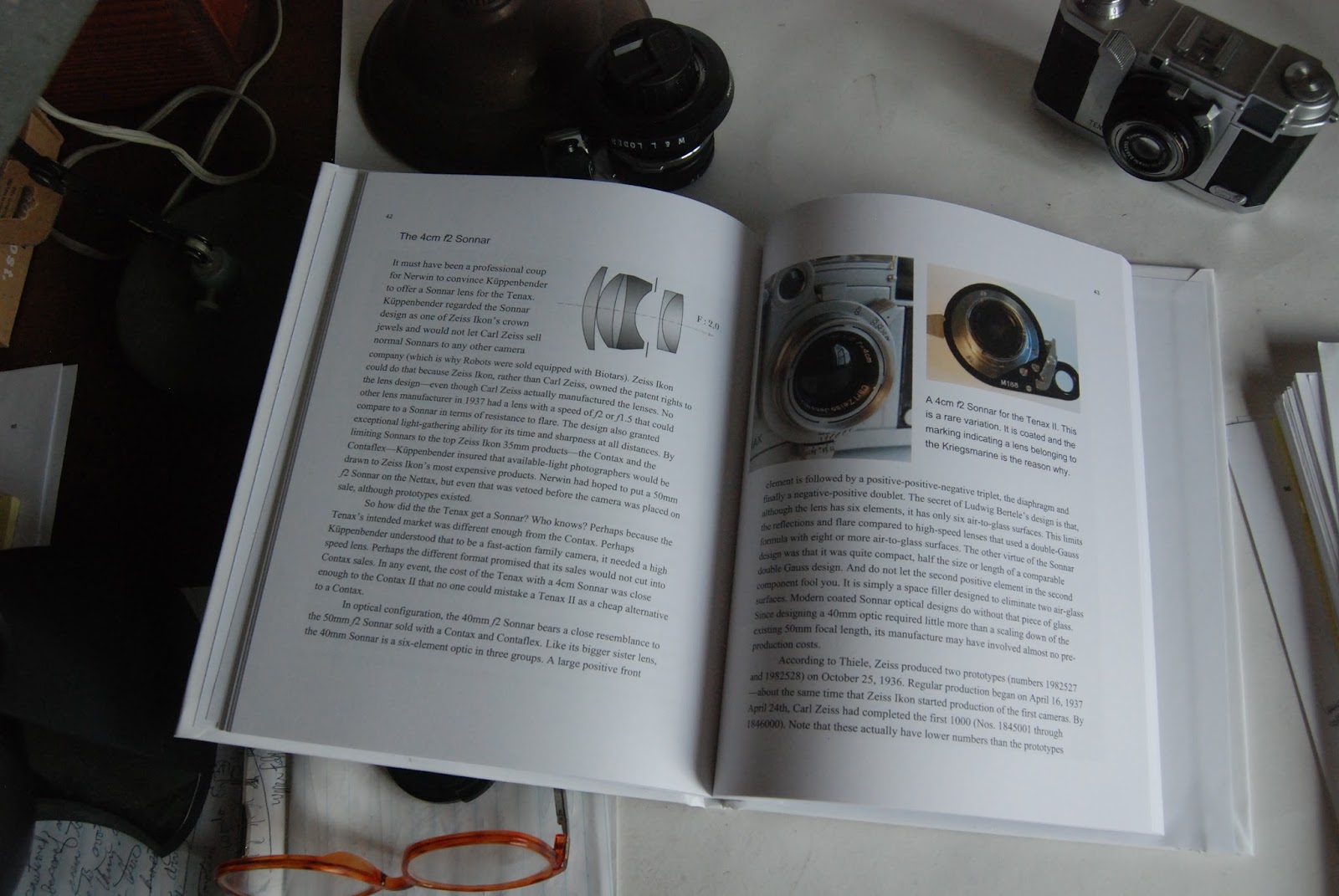
The 2.7cm f4.5 Orthometar, Zeiss Ikon's rare wide angle for the Tenax II

The 2.7cm Orthometar lens for the Tenax II. Note that this particular lens is marked in feet. It dates to October 1937, part of a patch of 100 built before the Tenax II camera was released for sale in April 1938.

Hubert Nerwin designed Zeiss Ikon's Tenax II camera of 1937 as a fast-action rangefinder camera with fully interchangeable lenses. That meant its lens offerings had to include at least one wide angle. This proved to be a bit of a challenge. There were few options in wide-angle designs in the 1930s. Initially the Contax had made do with a slow 2.8cm f8 Tessar that did not even couple to the rangefinder. The later fast and sharp 3.5cm f2.8 Biogon was the best wide-angle that any lens manufacturer could offer at that time, but its depth precluded its use on the Tenax. So Nerwin chose  an Orthometar design.
    The Orthometar was designed as an aerial lens by Dr. Robert Richter. As its name implies, it was particularly free of distortion—an important consideration in a lens used for aerial mapping. A modified double Gauss design, it appears similar to the 28mm f3.5 W-Nikkor for the Nikon RF cameras except for a much smaller back element.
    Zeiss also took the design and used it in a 3.5cm f4.5 lens for the Contax cameras—slower than the Biogon, but priced at a lower price point than the Biogon.
   Adapted for use on a 24X24 format camera, such  as the Tenax II, the 27mm focal length yields the same angle of view as a 34mm lens on a 24X36mm camera.

    Although it takes the same 34.5mm screw-in filters as the other lenses for the Tenax, the Orthometar optics are small, a mere 6mm across the front. Grinding the inner elements must have been a difficult and challenging task. The five aperture blades are also tiny. The spaces between aperture markings are even and the aperture closes down to f32. The barrel does not rotate when focused. This is a modern lens lacking only clickstops to make it comparable to any RF lens made today. It focuses down to less than three feet with a 30 degree swing of its under lens focusing lever.

Carl Zeiss made only three lots of this lens: two prototypes in 1937 (nos 2025791 and 2025792), then a production run of 100 finished on October 1st, 1937 (nos.2203301-2203400). A final run of 200  probably came close to a year later (nos 2360001-2360200). The lens was expensive ($132 dollars, or equivalent to over $2200 at 2017 rates) and the market for wide-angles limited. The outbreak of World War II less than a year-and-a-half after the camera’s introduction undoubtedly contributed to the low numbers and small sales.

With such a small production, it is a wonder that this lens is available at all, but I snagged the one illustrated here off ebay with a buy-right-now option complete with its finder and a Tenax camera and custom case. Unfortunately, the camera had been dropped, but with parts on hand I have been able to get everything back in working order.

The lens is easy to use and the results sharp. I like its compactness and easy to set controls.
More details on the Orthometar for the Tenax can be found in my book on the Tenax II, available from Blurb Books:
http://www.blurb.com/b/8032913-the-tenax-ii-zeiss-ikon-s-precision-fast-action-ca
Orthometar mounted on its original Tenax with finder 482/6

Orthometar images


The Tenax II: Zeiss Ikon's Precision Fast-action Camera


I recently put the finishing touches on my book on Zeiss Ikon’s Tenax II camera.

As followers of this blog know, I have been enamored of the Tenax II camera for some time. Having put a great deal of my time into researching the history of the Nikon rangefinder cameras, I decided to branch out a little and investigate one of Zeiss Ikon’s premier cameras in the period immediately before World War II.

I have now published a short book on this unique camera. It is

The Tenax II: Zeiss Ikon’s Precision, Fast-action Camera: A Pictorial Compendium and Gallery of Work.

It is available from Blurb books. Price: $38.49. 104 pages with over 100 full-color illustrations that combine detailed pictures of the camera and its accessories with historic advertisements and my own pictures taken with a Tenax and its lenses.
Go to:

http://www.blurb.com/bookstore/detail/8032913-the-tenax-ii-zeiss-ikon-s-precision-fast-action-ca

Monday, January 18, 2016

More lenses for a Tenax II


28mm f3.5 Auto Nikkor lens on a Tenax II. Finder is correct one (432/6) for the 2.7cm Orthometar

Rangefinder cameras and wide-angle lenses are an excellent combination. But what is a Tenax II user to do when the only wide-angle lens was a 2.7cm f4.5 Orthometar of which only 302 were manufactured? That is 1/10th the number of Orthometars made in 35mm for the Contax! But it appeared that there might be enough room to fit a Nikkor lens in F mount on a Tenax with the proper adapter.
I watched ebay and was finally rewarded with a lens mount for a 4cm Sonnar missing its optics. I took this lens mount and a Nikon K3 ring to a friendly machine shop and a month and a small fortune later, I had an adapter that will allow the mounting of some Nikon F mount lenses. I say "some" because while the bayonet mount is perfect, many Nikkors project beyond the bayonet flanges. Far enough and they hit the rear of the adaptor.
What works? A early  (non-AI) version of the 105mm f2,5 Auto Nikkor works fine. It appears that it might vignette only slightly. But what I wanted was a wide-angle. An early version of the 28mm f3.5 Auto Nikkor looked like it might work except for the back flange extension designed to protect the rear element of the lens.
 Two hours of careful filing and fitting, and the 28mm Nikkor fit. When combined with the proper 2.7cm Zeiss finder for the Tenax, I was all set. Except for lack of rangefinder focus and its size, it is a perfect combination. And it does not vignette.
Back of the adapter. Beautiful machining including a new latch.
Adapter front.

Our gate, taken with the 28-Tenax II Combo
Our backyard, taken with 28-Tenax II Combo

Tuesday, September 2, 2014

Closeups with a Zeiss Ikon Tenax II camera


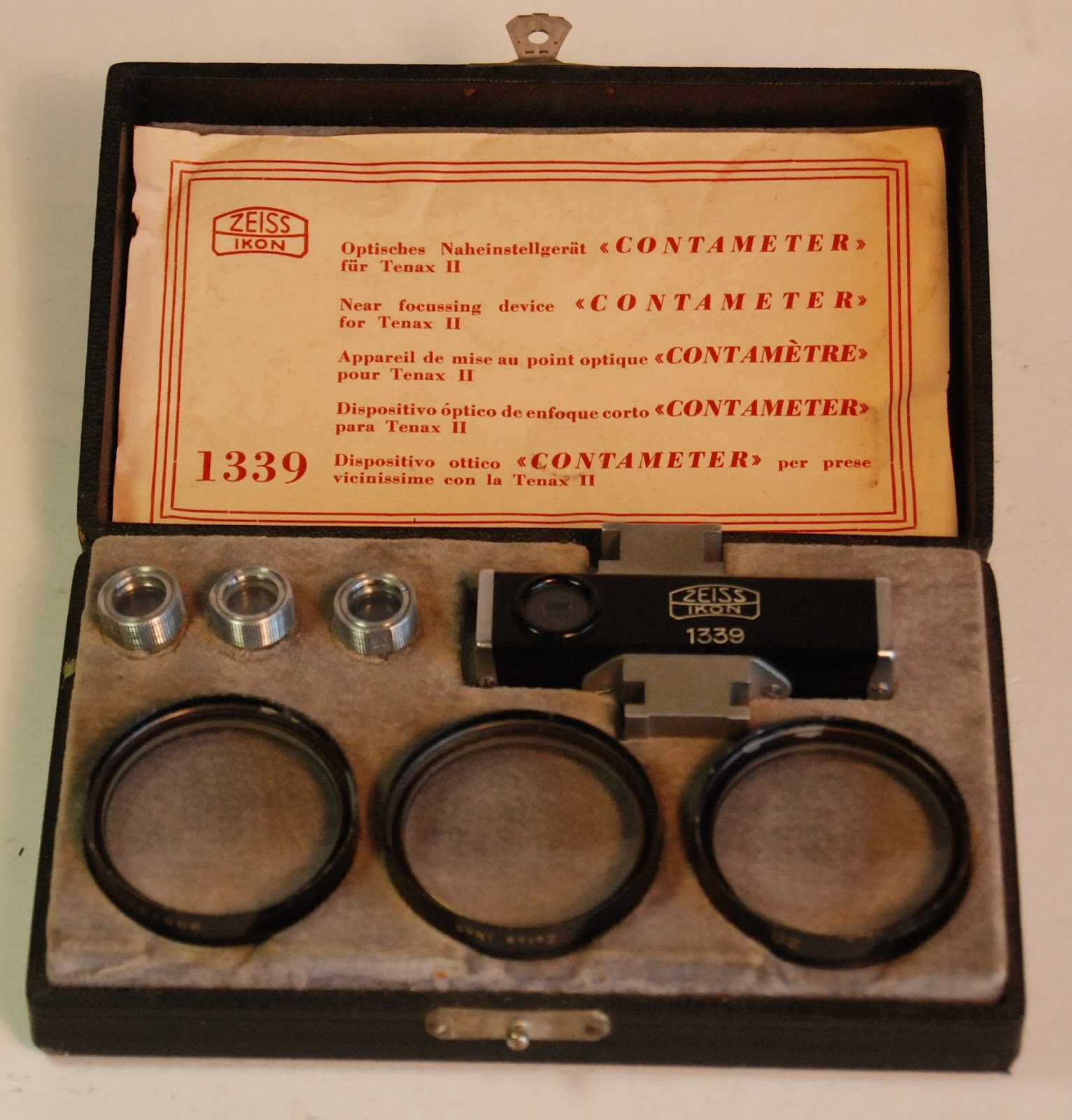
#1339 Contameter in its case


For the Tenax II owner who just had to do closeup photography, Zeiss Ikon offered a few accessories, either the same or modeled on those for the Contax rangefinder cameras.

Contameter 1339 mounted on a Tenax II
The best known was a Contameter, a combination of a rangefinder device and three closeup lenses that came as a kit. Each of the smaller Zeiss cameras had a Contameter designed specifically for that camera and its normal lens. The kit for the Tenax II was #1339. Other kits were #1340 for the Contax III, #1341 for the Super Ikonta B, #1342 for the Super Nettal and Nettax and, the mostly commonly still seen, #1343 for the Contax I and Contax II. At $65 each in 1930s dollars, these kits were expensive.

Each lens has a tiny matched focusing lens that fits onto the rangefinder focusing and framing device that goes onto the accessory shoe. In use, you do not focus the lens, but shift the camera back-and-forth until the rangefinder images match. It is simple to operate and requires no exposure adjustment, but one is limited to only three distances and setting up requires some time.

Bloodroot


Crocus on bloom

Cherry blossoms on Mayapple
 The 37mm slip-on closeup lenses for the Tenax II set consist of a #20, a #30 and a #50. When the 30 and 50 are used, the device mounts using one shoe; When the 20 is used, the Contameter uses the opposite shoe which adds additional tilt for the closer distance parallax. The #20 focuses to approximately 10 1/2 inches or 270mm, for a reduction of 1: 6.75. The #30 focuses to 15 inches or 380mm. The #50 is sharp at 21 inches or 530mm.

Contameter kit 1341 for the Super Ikonta B
Tenax II, 7.5cm Sonnar, #50 CU lens.
 The more widely-available #1341 Contameter can be used on the Tenax II since they both share the same square format and take the same size filters. The rangefinder focuser works with the #50 and # 70 lenses. It does not work with the #20. When the #50 is combined with the 7.5cm Sonnar, it works even better, since that was the focal length the 1341 closeup lenses were designed for.  The Contameter framing however is too wide.  For more information on the 7.5cm f4 Sonnar for the Tenax II go to: 7.5cm for Tenax II

In addition, Zeiss offered two Proxar closeup lenses, numbers 1 and 2. These were quite inexpensive at $5.25 each, but since they came with no framing or focusing, a user would have to use a tape measure to gauge distance.

The camera in these pictures is mounted onto a Micrometer, a device that allowed fine tuning of the distance of the camera from the subject. For more general and historic information on the Tenax II go to: Zeiss Ikon's Action Camera

4cm Sonnar, #50 closeup lens.

7.5cm Sonnar, #50 closeup lens.
 

Tuesday, April 29, 2014

The 7.5cm (75mm) Sonnar for the Tenax II

7.5cm f4 Sonnar for the 35mm 24X24 Zeiss Tenax II camera
[To see my earlier entries on the Tenax II camera below, go to: Tenax II action camera ].

Zeiss Ikon offered a selection of only four lenses for its Tenax II camera. The 7.5cm f4 Sonnar was its sole telephoto lens.
Tenax II with 7.5cm Sonnar and 433/17 albada finder for 4cm & 7.5cm lenses
Despite its limited range of lenses and the restricted development of a system of photography, everything Zeiss made for the Tenax II was first-class and of the same quality as accessories sold for the Contax. This is particularly true of its optics. The Tenax II and its lenses were not cheap ( the 7.5cm Sonnar was $120.00 in 1939), nor were they intended for the common amateur. Rather, they were aimed at prosperous, middle-class families who wanted a fast-action camera with interchangeable lenses for recording family and recreational activities.
The Carl Zeiss Jena 7.5cm Sonnar is a four element optic similar to the 135mm f4 Sonnar for the Contax. It is the same design as the 7.5cm for the Movikon movie cameras. Zeiss also made a number of these lenses in Robot mount. Construction is satin chrome over brass. The focusing is a double helicoid so the lens does not rotate during focusing. This is true for all the Tenax II lenses. The need to couple to the gears that drive the wedge focusing optics for the rangefinder may have required such a mounting. The non-clickstop diaphragm has settings to f22, and is double, resulting in a beautiful circular opening at all settings and an even spacing of the stops. The focusing lever sets below the lens and rotates counter clockwise for about 30 degrees to carry the focus from infinity to 1.5 meters (63 inches or a little over five feet).

Since the Tenax II shoots pictures that are 24 X 24 instead of the almost universal 24 X 36, the 7.5cm Sonnar offers framing that would be the equivalent of a 94mm lens in a full-format 35mm camera.

The Thiele database of Zeiss lens production indicates that a total of 1025 7.5cm Sonnars were manufactured in four groups. This is a much higher number than the rare 2.7cm Orthometar, the Tenax II’s only wide-angle, but as many as 50 of these shipped out in Robot mounts and it is possible that most if not all the last lot of 275 manufactured in 1940 went to the Kriegsmarine (German war navy) and ended up off at sea. So the 7.5cm Sonnar may be rarer than production numbers would suggest. However, a few 7.5cms have shown up with numbers that do not fit into Thiele's production series, so who knows?.
At least one 7.5cm has been seen without its rangefinder arm and equipped with a ring-driven helicoid. The author has seen two late 7.5s with Kriegsmarine inventory markings on their lens rear mounts. In both cases the numbers have a “MF” prefix. "M" stands for "marine," but I have not seen a consensus on what the "F' stands for. Some naval lenses have inventory numbers that just start with a "M."

The mount is the three-tang Tenax II standard and the back barrel seats well into the camera body. To mount, set the shutter speed to 1/50th or slower, line up the red dot of the lens with the red-marked pin, set the barrel in, rotate counter-clockwise about 30 degrees and the lens clicks into place. To remove, depress the top lever and rotate clockwise. The projecting arm of the lens houses the two wedge-shaped lenses that connect via gears to the outer helicoid. These lenses line up in front of the camera’s rangefinder window. As you focus, these lenses rotate, one clockwise, the other counter-clockwise, to cause the RF image to aline.

As is true of all Tenax II lenses. the 7.5cm Sonnar takes 35.5mm screw-in filters and 37mm slip-on accessories. Zeiss offered two Proxars, 1 and 2, in the 37mm slip-on type. The Proxar 1 mounted on a 7.5cm, allows focusing from 41 to 24 inches. To determine accurate focusing, one would need to set the camera on a tripod and use a tape measure.

Zeiss Ikon also offered a Contameter set (#1339) for the Tenax II but whether its lenses or focuser would work with the 7.5cm Sonnar is unknown. The focuser and the #50 lens from the #1341 set for a Super Ikonta B will work nicely at about 21 inches. See entry on closeup work with a Tenax II: Closeups with the Tenax II

The 7.5cm f4 Sonnar illustrated here came with the dent to the front rim you see, eliminating any possible use of screw-in filters. Otherwise, this blemish has no effect on the lens’ performance. However, when I received the lens, it had another problem: the helicoid would not turn. This was not expected. After completely disassembling the helicoid and the rangefinder arm, I was able to determine the problem lay in the gears that connect the wedge lenses to the outer helicoid.
The focusing gears for the 7.5cm Sonnar disassembled. The two small
gears rotate the front RF lens counter-clockwise and the larger gear
rotates the rear RF lens clockwise.

They set into the arm casting and were binding against the casting. The gears rode on pins that follow an eccentric path when rotated. By turning the pin screws slightly, I was able to shift the gears so they no longer rubbed the casting. But reassembly was a challenge. The gears and the two wedge lenses had to be exactly right to the tooth in order for the rangefinder image to appear to move horizontally as you focus the lens. Even one gear tooth off for either lens would result in a RF image that would appear to move up or down on a diagonal. Once that was corrected, I had to rethread the inner helicoid onto the outer so that the lens would set at infinity and the screw holes lined up. That also took time. In the end, it took me two days to determine the problem and fix it. Fortunately, none of this affected the optics which are in good condition with only one small scratch on the front element and no cleaning markings.
Claire & her mother.

Bloodroot in bloom.
Penns Creek near Poe-Paddy. Note the flare.


Easter egg hunt.
Repairman's mark from distant past.
Assembly number on focus tab.

Kriegsmarine inventory number on rear mount partly removed by previous owner.

Assembly number on helicoid. Note the careful engraving.
Performance is about what one can expect for a uncoated lens. It flares in direct sunlight but yields nice, sharp images indoors or pointed away from the sun. It is so small and compact that weight is never a problem.

 Framing is another issue. Zeiss Ikon offered two options: one, a combination 40/75 albada finder, the other a mask that clipped onto the studs on either side of the Tenax’s finder window. Good luck finding either possibility!

Older lens on left, later lens on right.
For the student of the manufacturing changes that occur over time and due to war, here are two 7.5cm Sonnars, both in Tenax II mount for comparison.

Both lenses appear to be the same, but a closer examination reveals a range of differences.

The first (2246175) is an early production lens, one of the first 200 built in three lots in January 1938—only a few months before the public release of the Tenax camera. It is the earliest serial number in my records. It is an export lens intended for sale to either the British or American market.

Features:
1) The engraving of the the beauty ring is bolder and larger than the later lens, and not as sharp. It does not include slots for a spanner wrench.
The distance scale is in feet and begins with “Inf.”
“Made in Germany” is engraved on the outer edge of the lens mount.
The chrome finish appears to be a high quality. The ding on the front-rim has not resulted in any chrome flaking. A poorly-done straightening has resulted in a crack in the rim. One can screw in a filter part-way.

The second lens (2543494) is from Thiele’s third lot of 150 dated to April 1939. With the Second World War less than five months away, most of this lot may have been intended for the German military.

The engraved letters and numbers on the beauty ring are finer, smaller and better defined. The beauty ring includes slots for a spanner wrench.
The distance scale is in meters and begins with “∞”.
No indication as to the country of manufacture other than the “Carl Zeiss Jena” marking.
The chrome finish is poorer with a bit of flaking where the filter rim was dinged and and a rub-though mark on the barrel. On the other hand, the lens-release shows no pitting, while the earlier lens does.
It is engraved “MF818” on the rear of the lens mount. This has been ground down to hide the number, but the letters and number are still easy to see. This is a military mark indicating a lens for the Kriegsmarine (“war navy”). In the picture you can see how the mark was applied with a hand-held engraving tool.
The later lens with the distance scale in meters

The early lens with distance scale in feet.
Made in Germany engraved on rim of early lens.

Closeup of military engraving on lens flange


The glass on both lenses are in fair condition. The early lens has clear front glass with the slightest hint of cleaning marks, but the back element has a haze that hints at the possibility of fungus. The later lens has a scratch on the front surface but no apparent cleaning marks. The front glass is not as clear as the earlier lens but the back element is beautifully clear and clean. Take your pick as to which will be the better user.