Tuesday, July 29, 2014

The Nikon rangefinder cameras and reflex housings

50cm f5 Nikkor and the view
This entry covers reflex housings (sometimes called "mirror boxes") that fit and work on Nikon's series of interchangeable rangefinder cameras. You are also welcome to look at my earlier site on the 500mm (50cm) f5 Nikkor in short mount, one of Nikon's early lenses for its reflex housings [http://www.personal.psu.edu/mwl2/500/500Nikkor.htm]. This is a condensation of a series of articles that appeared earlier in the Nikon Historical Society's Journal.

The entries will cover the six housings shown below. All will fit on a Nikon RF camera and allow infinity focus with their own lenses.
 Kilfitt kilfascope with cable, Novoflex, Panflex II, Panflex model 1, Nikon reflex housing, model I, Nikon Housing model II
Each one has its values and idiosyncrasies.

The Kilfascope was one of Kilfitt's second series housings. It has a forty-five degree angled finder that provides a right-side-up and laterally-correct view similar to Kilfitt’s earlier Repriscope. The mirror is spring-loaded in the up position. Pressing down on a button on the left side of the housing lowers the mirror and a connecting cable plugged into the right side holds the mirror in the correct position. This cable screws into the camera’s cable release socket. Pressing down on the button causes the pin to withdraw, releasing the mirror, followed by the firing of the shutter. It is impossible to get out of sync and the action is as fast as the photographer’s finger, permitting rapid firing and film advancing. Re-lowering the mirror is awkward. The view in the finder is reduced but bright with both the landscape and portrait views outlined by overlapping horizontal and vertical boxes. The camera may be rotated, allowing either view to be used without having to turn the housing on its side. Short-mount lenses included a 90mm f3.5, a 135mm f4, 150mm f4.5, 300mm f5.6 and a 400mm f5.6, still famed for their lightness and sharpness. Many were sold with adaptors for use on Arriflex movie cameras. All came in Leica-thread. Focal lengths 150mm and longer will focus to infinity on a Contax-mount housing as seen below. Unfortunately, their single helical focusing rings tend to shift whenever one closes down the diaphragm. In addition, their focusing helicoids turn in the opposite direction of Nikkor lenses in Nikon mount. Early versions of these lenses had manual diaphragms. Later ones were preset. Kilfitt used rubber bands for its focusing and aperture rings. In many cases these have stretched and no longer fit tightly, or are even missing.  In addition, their back rings are so thick that they get in the way of mounting the reflex housing on a large-based tripod.
The 150mm Kilar lens is particularly sweet: light, compact and it takes 52mm filters.

The 300mm f5.6 Kilar in Leica short-mount. Behind is a Novoflex housing also with a 300mm f5.6 lens. These housings have a Contax bayonet in back and Leica thread in front. Both units work on a Nikon rangefinder camera.

Image: Landscape taken with 300mm Noflexar. Note the vignetting, a problem with all long-focus lenses and the Nikon RF cameras.

The Novoflex housing also came in either a waist-level version or one with a fixed 45 degree finder. The 45 degree finder can be rotated 360 degrees, allowing its use from a variety of positions. The mirror box in the Contax/Nikon mount version, 98mm in depth, is deeper then the Visoflex standard, but it still has a Leica thread front mount. The mirror is spring loaded up. A lever on the right side of the box cocks the mirror. A metal bridge release that mounts on the camera links the shutter release to one of two small buttons, one for the horizontal viewpoint, the other for the vertical setting that, in turn, release the mirror. The camera may be rotated for vertical or horizontal and the viewfinder rotates with it in the same way Nikon’s second housing does. In action, this housing is one of the best designed and integrated, but if one is missing the bridge, fast action is impossible. It is not known if Novoflex ever offered a bridge to fit the Nikon rangefinder cameras. Novoflex offered a special bellows that locked onto the housing using its tripod screw. The bellows has the ubiquitous Leica thread mount and Novoflex sold a wide range of barrel mount lenses to go on this bellows, ranging from 135mm through 300mm. Unfortunately, the bellows must be focused using the right-hand knob, the left hand serving as a lock. This limits action photography.
30cm f5.6 Noflexar mounted on the Novoflex reflex housing and Nikon SP. Note the home-made bridge
Wolfgang Jacobi, designer of the Panflex in his office in the 1930s. {courtesy of Zeiss Historica Society).


In addition, the Contax-mount Novoflex housing can take longer Noflexar lenses that use their original fast-focus pistol grip. The rapid-focus bellows in Leica thread mount will take 240mm Noflexars and longer. The Leica-thread Pistol-grip focuser will handle the early 300mm Noflexars and longer focal lengths. The later breech-lock mount focusers will only mount on the Leitz Visoflex II.

The first model of the Panflex and the Nikon Reflex housing, model 1, side-by-side for comparison. Their operation is almost the same, but the Nikon housing looks like a Leitz PLOOT housing.
The Zeiss Panflex was designed for closeup work by Wolfgang Jacobi, a designer of accessories within the WICO department (WIssenschaftliche COntax Photography or Scientific Contax Photography department). It has the external Contax mount on the front, allowing a wide range of Contax/Nikon mount lenses, 85mm and longer to be mounted. The pre-war version did not have any particular lenses in short mount designed for it. A 135mm f4.5 Tessar in short mount was prototyped but never put into production. To change from landscape to portrait view, one must use one or the other of the two 3/8” tripod sockets provided. The view through the fixed finder is laterally reversed and upside down, making any field work challenging. A cable release attaches underneath the side housing, a coupling cable projects out the top. Pressing on the cable release forces up the mirror, then the connecting cable which, in turn, depresses the camera shutter release.   It is similar to Zeiss’ Flektoskop (also a Jacobi design) in shape, finder, operation and view, but smaller. It has the external Contax mount on the front, allowing a wide range of Contax/Nikon mount lenses, 85mm and longer to be mounted.

The post-war Panflex II follows the general pattern of the first Panflex but with a number of definite improvements. The view is laterally and vertically correct. A plunger behind the connecting cable allows picture taking without a cable and without moving the hand off the camera. Unfortunately, the 115mm f3.5 Panflex Tessar was the only lens officially sold for the post-war version and it is hard to find and expensive. The connecting cable requires a shallow-depth adapter when used on a Nikon. The Panflex II is easy to operate and use. The tripod mount rotates from horizontal or vertical.

Nikon (Model I)

Rare and strange. Waist-level finder and body modeled on the Leitz PLOOT model housing, but cable system follows ideas of Panflex model I with a cable release or “Finger-tip” release screwing in below the side housing. In use, you push up, forcing the mirror up, then the connector cable.  View is upright but laterally reversed. Exchanging the finder-tip release for a cable release is inconvenient. The release delay is adjustable. The body can be rotated horizontal to vertical with spring-loaded lock to set position, but the view does not rotate. Instead, a cross-shaped mask over the ground glass allows both views to be seen. The Nikon housings have the greatest depth of any housings, limiting focal lengths to 180mm and longer except for the bellows-mount 135mm.

Although first mentioned in 1952, it appears that the first Nikon reflex housing did not make it to market until late in 1954. Fewer than 200 may have been sold before Nikon replaced it with the Model II in May 1956.

Nikon (Model II)

This last model housing for the Nikon is rounded and finished in crinkle-black. It takes the same connecting cable as Model I, and one can substitute a cable for the Nikon pistol grips. The socket for the release is on top of side and forward. The socket is threaded for an external cable release but only the Nikon “Finger-tip release” or the special cable release will work without modification due to the long, narrow plunger needed to push up the mirror. Mirror is spring-loaded down but the slightest pressure on the release will cause it to start to rise, shifting focus. The is probably the most awkward and user-unfriendly housing for the RF Nikons. Shutter release delay is adjustable. 45 degree finder is removable. A few 90 degree pentaprism finders were made late in the RF period. Viewer is bright with a plain ground glass and is large enough that taking in the entire screen can be difficult. A button on the left side allows camera rotation with a locking position for vertical and horizontal. View in finder shifts with the rotation. 


Monday, July 21, 2014

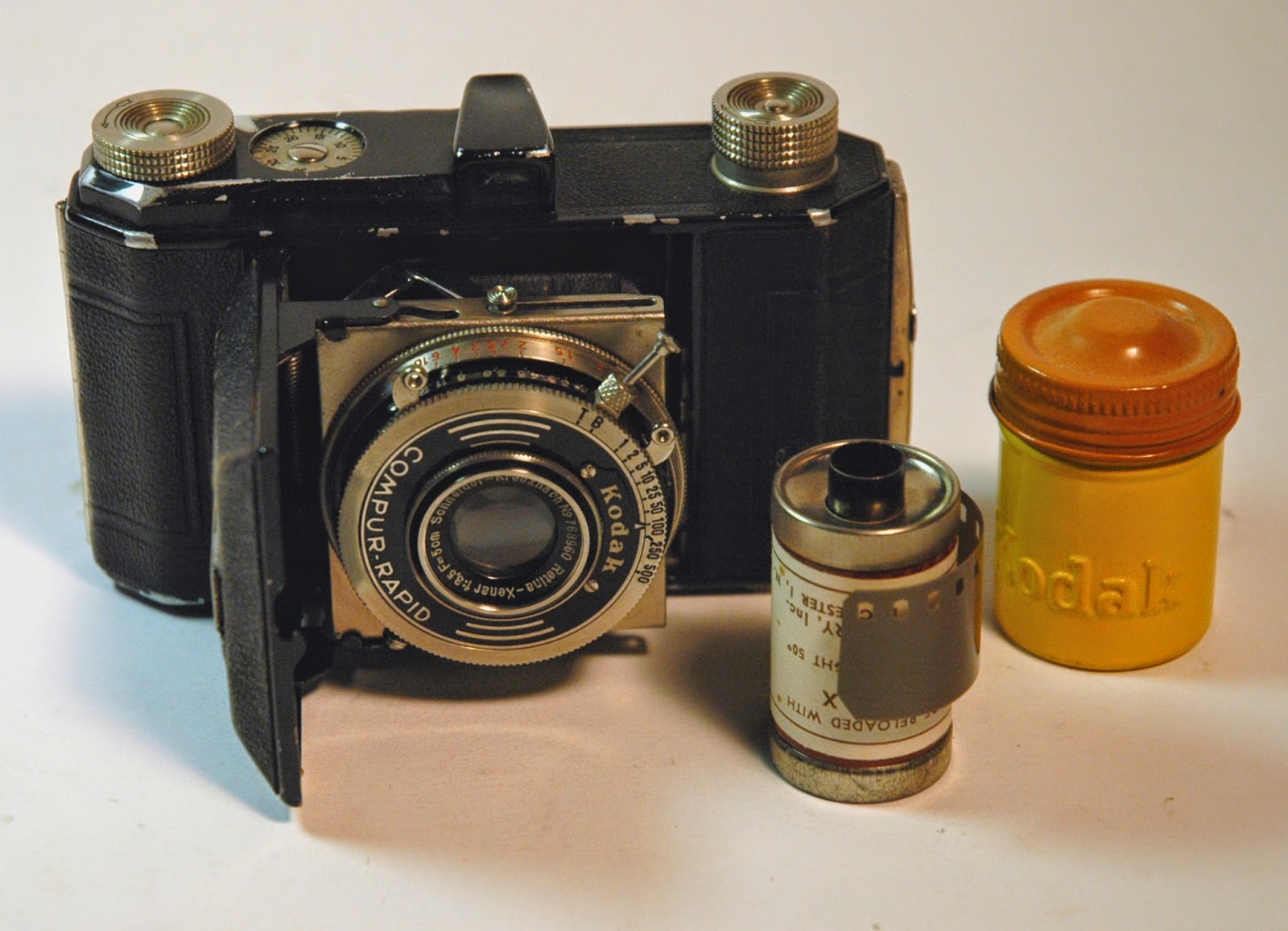
My humble Retina 35: a pocketable camera

Around 1977, I was looking for a truly pocketable 35mm camera that I could take with me for casual shooting—something that none of my Nikons allowed. At that time I was living in Eugene, Oregon, a university town with an active photographic community. It even had a store that specialized in selling only used cameras. It was in that store that I located this Retina I and, after promising that I would actually use it for taking pictures, the owner sold it to me for a modest sum. I have run a number of rolls through it over the years, but in the end its liabilities outweighed its virtues and currently I use other cameras for my film photography.

This is a solid, compact camera and folded, it slips readily into a jacket pocket or belt case. The Compur-rapid shutter with speeds to 1/500th of second stills works and has never given me any trouble. The unit-focusing 5cm f3.5 Xenar lens is decent and capable of good results within the limits of an uncoated lens. On the other hand, the finder is squinty. The controls are tiny and setting the aperture is difficult. The depth-of-field scale is on the bottom of the camera and impossible to access if the camera is in its case. But the biggest problem is the lack of double-exposure prevention. If one always remembers to advance the film immediately after taking a picture, then maybe that problem goes away, but I used this camera so seldom that good habits never formed.

The Retina series of 35mm cameras were the brainchild of Dr. August Nagel, former head of the Contessa-Nettal AG company in Stuttgart who walked away from the merger of his company with Zeiss Ikon to continue his own company. Deciding that 35mm film cameras were more than a passing fancy, Eastman Kodak bought Nagel Camerawerk, and began manufacturing the Retina I in 1934.  This type 119 (1936-1939) is similar to the earlier two models but the lines are cleaner and the frame counter sets into the camera top. The black painted finish, nickel trim and fine-grain leather covering have held up well.

Note the still-unexposed roll of Eastman film in the picture. It is a 20-exposure roll of Eastman Plus-X (exposure index: 50), nitrate base, and a contemporary of this camera. Do not get a flame near it! Nitrate film is highly flammable. This picture also appears as an illustration in my book on the early history of the Nikon camera.

Tuesday, April 29, 2014

The 7.5cm (75mm) Sonnar for the Tenax II

7.5cm f4 Sonnar for the 35mm 24X24 Zeiss Tenax II camera
[To see my earlier entries on the Tenax II camera below, go to: Tenax II action camera ].

Zeiss Ikon offered a selection of only four lenses for its Tenax II camera. The 7.5cm f4 Sonnar was its sole telephoto lens.
Tenax II with 7.5cm Sonnar and 433/17 albada finder for 4cm & 7.5cm lenses
Despite its limited range of lenses and the restricted development of a system of photography, everything Zeiss made for the Tenax II was first-class and of the same quality as accessories sold for the Contax. This is particularly true of its optics. The Tenax II and its lenses were not cheap ( the 7.5cm Sonnar was $120.00 in 1939), nor were they intended for the common amateur. Rather, they were aimed at prosperous, middle-class families who wanted a fast-action camera with interchangeable lenses for recording family and recreational activities.
The Carl Zeiss Jena 7.5cm Sonnar is a four element optic similar to the 135mm f4 Sonnar for the Contax. It is the same design as the 7.5cm for the Movikon movie cameras. Zeiss also made a number of these lenses in Robot mount. Construction is satin chrome over brass. The focusing is a double helicoid so the lens does not rotate during focusing. This is true for all the Tenax II lenses. The need to couple to the gears that drive the wedge focusing optics for the rangefinder may have required such a mounting. The non-clickstop diaphragm has settings to f22, and is double, resulting in a beautiful circular opening at all settings and an even spacing of the stops. The focusing lever sets below the lens and rotates counter clockwise for about 30 degrees to carry the focus from infinity to 1.5 meters (63 inches or a little over five feet).

Since the Tenax II shoots pictures that are 24 X 24 instead of the almost universal 24 X 36, the 7.5cm Sonnar offers framing that would be the equivalent of a 94mm lens in a full-format 35mm camera.

The Thiele database of Zeiss lens production indicates that a total of 1025 7.5cm Sonnars were manufactured in four groups. This is a much higher number than the rare 2.7cm Orthometar, the Tenax II’s only wide-angle, but as many as 50 of these shipped out in Robot mounts and it is possible that most if not all the last lot of 275 manufactured in 1940 went to the Kriegsmarine (German war navy) and ended up off at sea. So the 7.5cm Sonnar may be rarer than production numbers would suggest. However, a few 7.5cms have shown up with numbers that do not fit into Thiele's production series, so who knows?.
At least one 7.5cm has been seen without its rangefinder arm and equipped with a ring-driven helicoid. The author has seen two late 7.5s with Kriegsmarine inventory markings on their lens rear mounts. In both cases the numbers have a “MF” prefix. "M" stands for "marine," but I have not seen a consensus on what the "F' stands for. Some naval lenses have inventory numbers that just start with a "M."

The mount is the three-tang Tenax II standard and the back barrel seats well into the camera body. To mount, set the shutter speed to 1/50th or slower, line up the red dot of the lens with the red-marked pin, set the barrel in, rotate counter-clockwise about 30 degrees and the lens clicks into place. To remove, depress the top lever and rotate clockwise. The projecting arm of the lens houses the two wedge-shaped lenses that connect via gears to the outer helicoid. These lenses line up in front of the camera’s rangefinder window. As you focus, these lenses rotate, one clockwise, the other counter-clockwise, to cause the RF image to aline.

As is true of all Tenax II lenses. the 7.5cm Sonnar takes 35.5mm screw-in filters and 37mm slip-on accessories. Zeiss offered two Proxars, 1 and 2, in the 37mm slip-on type. The Proxar 1 mounted on a 7.5cm, allows focusing from 41 to 24 inches. To determine accurate focusing, one would need to set the camera on a tripod and use a tape measure.

Zeiss Ikon also offered a Contameter set (#1339) for the Tenax II but whether its lenses or focuser would work with the 7.5cm Sonnar is unknown. The focuser and the #50 lens from the #1341 set for a Super Ikonta B will work nicely at about 21 inches. See entry on closeup work with a Tenax II: Closeups with the Tenax II

The 7.5cm f4 Sonnar illustrated here came with the dent to the front rim you see, eliminating any possible use of screw-in filters. Otherwise, this blemish has no effect on the lens’ performance. However, when I received the lens, it had another problem: the helicoid would not turn. This was not expected. After completely disassembling the helicoid and the rangefinder arm, I was able to determine the problem lay in the gears that connect the wedge lenses to the outer helicoid.
The focusing gears for the 7.5cm Sonnar disassembled. The two small
gears rotate the front RF lens counter-clockwise and the larger gear
rotates the rear RF lens clockwise.

They set into the arm casting and were binding against the casting. The gears rode on pins that follow an eccentric path when rotated. By turning the pin screws slightly, I was able to shift the gears so they no longer rubbed the casting. But reassembly was a challenge. The gears and the two wedge lenses had to be exactly right to the tooth in order for the rangefinder image to appear to move horizontally as you focus the lens. Even one gear tooth off for either lens would result in a RF image that would appear to move up or down on a diagonal. Once that was corrected, I had to rethread the inner helicoid onto the outer so that the lens would set at infinity and the screw holes lined up. That also took time. In the end, it took me two days to determine the problem and fix it. Fortunately, none of this affected the optics which are in good condition with only one small scratch on the front element and no cleaning markings.
Claire & her mother.

Bloodroot in bloom.
Penns Creek near Poe-Paddy. Note the flare.


Easter egg hunt.
Repairman's mark from distant past.
Assembly number on focus tab.

Kriegsmarine inventory number on rear mount partly removed by previous owner.

Assembly number on helicoid. Note the careful engraving.
Performance is about what one can expect for a uncoated lens. It flares in direct sunlight but yields nice, sharp images indoors or pointed away from the sun. It is so small and compact that weight is never a problem.

 Framing is another issue. Zeiss Ikon offered two options: one, a combination 40/75 albada finder, the other a mask that clipped onto the studs on either side of the Tenax’s finder window. Good luck finding either possibility!

Older lens on left, later lens on right.
For the student of the manufacturing changes that occur over time and due to war, here are two 7.5cm Sonnars, both in Tenax II mount for comparison.

Both lenses appear to be the same, but a closer examination reveals a range of differences.

The first (2246175) is an early production lens, one of the first 200 built in three lots in January 1938—only a few months before the public release of the Tenax camera. It is the earliest serial number in my records. It is an export lens intended for sale to either the British or American market.

Features:
1) The engraving of the the beauty ring is bolder and larger than the later lens, and not as sharp. It does not include slots for a spanner wrench.
The distance scale is in feet and begins with “Inf.”
“Made in Germany” is engraved on the outer edge of the lens mount.
The chrome finish appears to be a high quality. The ding on the front-rim has not resulted in any chrome flaking. A poorly-done straightening has resulted in a crack in the rim. One can screw in a filter part-way.

The second lens (2543494) is from Thiele’s third lot of 150 dated to April 1939. With the Second World War less than five months away, most of this lot may have been intended for the German military.

The engraved letters and numbers on the beauty ring are finer, smaller and better defined. The beauty ring includes slots for a spanner wrench.
The distance scale is in meters and begins with “∞”.
No indication as to the country of manufacture other than the “Carl Zeiss Jena” marking.
The chrome finish is poorer with a bit of flaking where the filter rim was dinged and and a rub-though mark on the barrel. On the other hand, the lens-release shows no pitting, while the earlier lens does.
It is engraved “MF818” on the rear of the lens mount. This has been ground down to hide the number, but the letters and number are still easy to see. This is a military mark indicating a lens for the Kriegsmarine (“war navy”). In the picture you can see how the mark was applied with a hand-held engraving tool.
The later lens with the distance scale in meters

The early lens with distance scale in feet.
Made in Germany engraved on rim of early lens.

Closeup of military engraving on lens flange


The glass on both lenses are in fair condition. The early lens has clear front glass with the slightest hint of cleaning marks, but the back element has a haze that hints at the possibility of fungus. The later lens has a scratch on the front surface but no apparent cleaning marks. The front glass is not as clear as the earlier lens but the back element is beautifully clear and clean. Take your pick as to which will be the better user.

Wednesday, January 8, 2014

The two Instruction Booklets for the Nikon S2


The first Nikon S2 Instruction booklet on the left dating to 1954. The second version on the right dating to mid-1956.
With the establishment of a new distributor for its products in the United States, Ehrenreich’s “Nikon, Inc.,” Nippon Kogaku revised the instruction books that came with its cameras.

The bright and colorful covers that appeared starting in 1954 with the late-production model Nikon S cameras were the work of Yusaku Kamekura of Nippon Design Centre. They established a “look” to Nippon Kogaku’s advertising that persisted up to the changeover to the gold books and boxes of the 1960s.

While as the Nikon SP, S3 and S4 all had only one instruction booklet that remained unchanged throughout the production life of each model, the S2 had two different ones. The reason lies in the illustrations, some of which appear here.

The first instruction booklet would have been assembled in the autumn of 1954 shortly before the public announcement of the Nikon S2 in December 1954. All the illustrations show a chrome-dial camera and a chrome-finished normal lens. This was still the standard in 1954. What is more curious is that the lens page shows only the lenses from 25mm to 135mm, ignoring the longer lenses for the reflex housing. But apparently only the 250mm Nikkor was out of the prototype stage at that point, so these were not really available.

The other major difference is the variable-focal finder, still shown with the parallax adjustment above the shoe.
The second version must date from the spring of 1956, for the new Micro-Nikkor does not appear in the display on the next-to-last-page, but the 50mm f1.1 Nikkor does. The second version of the reflex housing is there, as are its lenses and even the Leica-thread mount versions of the rangefinder optics. Note also that the variable-focal finder illustrated is the final version with the parallax adjustment moved to a ring around the finder eyepiece. But the biggest change is that the normal lens on all the camera shots is a black-finished 50mm Nikkor and all but one of the other Nikkors are in their final black-mount versions. That is the major reason NK decided to go with a new version of their S2 instructions.
The lens page from the first S2 instructions. Note that none of the reflex housing, short-mount lenses are shown. Lenses are still chrome-finished.

The lens page from mid-1956. Note the added lenses, now in their black-mount versions.

Anyone know if the pictures got changed again when the S2 morphed into the black-dial version of the camera in the fall of 1957?

Saturday, December 21, 2013

Black and White images from my Tenax II camera

Shadows across the field and valley below our home.
Some black-and-white images I have taken using my Tenax II 35mm camera manufactured in 1938.
West profile of our off-grid, passive solar home in Pennsylvania

Grandson Mo helping in the garden.

Sunday, November 24, 2013

Two 135mm Nikkors: A Study in Contrasts

Two 135mm f3.5 Nikkors: 1951 and 1959, with hoods.
For much of the 35mm camera era, a 135mm lens was the most popular auxiliary focal length for  most photographers. A 135 combined moderate telephoto length, moderate speed and a modest price in a compact enough body that a photographer did not have to think twice about taking it with him or her. It made an decent portrait lens and was also good for most sports coverage. It was also the longest focal length that most interchangeable rangefinder 35s could handle and still allow focusing accuracy.

The 135mm f3.5 Nikkor-Q was to prove to be Nippon Kogaku’s most popular accessory lens for their rangefinder camera series. Rotoloni in his book on the Nikon rangefinder camera* estimates that the company produced more than 30,000 over a 13 year period from 1951 until 1964. A few prototypes went out in 1950 with full production starting in January 1951—concurrent with the earlier 135mm f4 Nikkor that dated back to 1948. For a few months production of the two optics continued side-by-side with the older optic selling mostly to the Occupation forces  and the new, faster optic going to the United States where its speed gave it a sales edge over the similar Zeiss 135mm f4 Sonnar.

All 135mm f3.5 Nikkors are similar in size and features. They all focus down to five feet, all take 43mm screw-on accessories and all have a built-in tripod bushing. All of them use the same tele-Sonnar optical formula—a formula Nikon would carry over to its reflex camera lenses in 1959. But the company made a lot of other changes over the lens’ production lifetime.
Changes in minimum f-stops

The "Tokyo" mark on the early Nikkor


The two 135mm f3.5 Nikkors in these pictures help give an idea of some of those changes. The all-chrome-finished Nikkor is an “Occupied-Type II” lens probably dating to late spring of 1951. Serial numbers in this series begin with 253XX. The beauty ring is engraved “Nippon Kogaku Tokyo.” The diaphragm closes down to only f16 and the distance scale starts with “Inf.” Lenses meant for sale in the military exchanges were still being engraved with “Made in Occupied Japan” on their rangefinder engagement cams. Perhaps the Central Purchasing Office (CPO) still wanted that mark, or perhaps this was because NK still had a bunch of engraved cam rings in stock and could not afford to waste good parts.
The barely-visible "Made in Occupied Japan" on the 135's RF linkage ring.

With chrome-over-brass construction throughout, this is a heavy lens, weighing 22.5 ounces (639 grams). It is heavier than either a Nikon S2 or SP camera.

The black-finished 135mm Nikkor dates from 1959. The ribbing is bolder making focusing easier. The body is mostly aluminum and now weighs only 14 ounces (398 grams), a reduction in weight of over 40 percent. The focus scale starts with the infinity mark, a change that dates back to 1956. The lens stops down to f32 and the beauty ring now says “Nippon Kogaku Japan.” Another change is the absence of the red ‘C’ past the “Nikkor-Q” engraving. This first appeared on all Nikkors in 1946 and indicated that the lens was coated. By 1959 this was no longer seen as a notable feature since virtually all optical lenses were by then routinely coated, and NK had dropped that code.

Earlier telephoto Nikkors came with heavy, screw-on lens hoods that reversed onto the lens for storage and came apart to allow use of series 7 filters. A lens cap, in turn, reversed threaded onto stored hood. In 1956, NK went to snap-on hoods that still could be reversed, along with snap-on caps that could be used on either the reversed hood or the directly on the lens.

* Robert Rotoloni. The Complete Nikon Rangefinder System. Hove Foto Books, 2007.

Copyright. Michael W. Loder 2013. All rights reserved.

Thursday, November 7, 2013

The Tenax II: Zeiss' Action Camera from 1938: an essay with pictures


Zeiss Ikon Tenax II from 1938 with 4cm Sonnar


Tenax II [Zeiss Ikon Catalog number 580/27]

This essay is a summary of the material covered in depth in my book

The Tenax II: Zeiss Ikon's Precision Fast-action Camera 

see URL: <http://wesloderandnikon.blogspot.com/2017/07/the-tenax-ii-zeiss-ikons-precision-fast.html>


    The Zeiss-Ikon Tenax [II] of 1936-1941 was to be the director of camera design Hubert Nerwin’s masterpiece, combining high quality, precision and finish in a fast-operating and easily-handled, compact 35mm camera. Its images are in the rare 24mm X 24mm format. Most sources indicate an availability for only three years: 1938-1940. But production started in 1937 (E preface numbers), reached a high in 1938 (H numbers) with a continuing production into 1939 (I.H. and J numbers). A few, but not many, may have been assembled later. Zeiss Ikon first showed the camera at the Leipzig fair in April 1938. Total manufactured numbers may never be known. Simon Worsley has estimated 8500, with 2000 in 1937, 3000 for 1938, and another 3500 in 1939-1040.
    A few Tenax have “Made in Germany” engraved on their accessory shoes in front of their serial numbers. All of these have serial numbers in the E or H series dating them to 1937-1938. All appear to have been sold at a time when foreign exports were still important and possible. Most fall in the first 800 numbers of the H series and were intended for the North American market. These export cameras also have their lenses’ distance scales marked in feet rather than meters and sport 1/4 inch thread tripod sockets.
   Zeiss Ikon aimed its marketing toward a prosperous upper middle class customer looking for a high-quality, fast-action camera. It may have particularly appealed to women wishing to record family and social events.  At $207.00 American for the Sonnar-equipped version, the Tenax II was beyond the reach of most of the camera buying public. For those with deep pockets or professional needs, the more sophisticated Contax or Leica with their wide range of lenses and accessories must have seemed to be the better investment.
     Most of our knowledge of the Tenax comes from interviews with the late Hubert Nerwin, ebay and auction listings, the Thiele databases and the research done by Peter Dechert, Bernd K. Otto and, more recently, Larry Gubas.
   New ebay listings show up a couple of times a month. Tenax that start low sell, but so far the highest “sold” price I have found was for a Tenax in South Korea at $499.00. Tenax offered at ebay "start" prices over $500 seldom sell, despite repeated re-listings. Tenax with the more modest Tessar lens often sell for less than $400.00. Few of the auxiliary lenses have shown up and with prices over $800.00, they do not sell either. Auction prices cover a wide range. In the early 00s, high prices seemed to be the norm, but by 2009 the prices had dropped to close to ebay’s. Recent auction prices have been higher. The Westlicht Auction House seems to be the only place where the rare auxiliary lenses and accessories appear. By contrast, the relatively plentiful and unglamorous Nikon S with over 34,000 built, routinely sells for more than $400.00. The Tenax and its accessories may be collectors’ items, but not enough to send the prices up to the Leica and Nikon levels.

German Naval Sonnar lens for Tenax II.
Note the number on the rear mount.
       A number of variations have shown up. Both the German Navy (Kriegsmarine) and Luftwaffe used the Tenax. Surviving naval cameras and/or their lenses have an added “Mxxx” or "MFxxx" inventory number as well as regular serial numbers. The M stands for "Marine." No one can agree on what the "F" means. Luftwaffe Tenax seen have "Luftwaffe Eigentum" engraved on their accessory shoes.
    The Tenax body also was the basis for a closeup camera body used during the war that lacked the body’s viewfinder/rangefinder and shutter, but did have an over-sized advance and larger counter and a huge rewind crank. These were used for photographing X-rays and on microscopes—a purpose the square-framed camera was probably ideal for.
Start of autumn

Grammy reading to Charlotte, age 8 months.


Leaf on our driveway. Ektachrome ASA 100

    The Tenax came without flash synchronization, but this must have been a popular after-market addition. More than a dozen Tenax have appeared on ebay with added PC posts. Location of the synch posts include left front, right front low, left of accessory shoe on top and right of the accessory shoe on top. Some of the adaptations appear crude, others are so well finished they look like factory jobs.

Lens production is another question, with a few showing 1936 numbers and the balance falling in Zeiss number ranges for either 1937-1939. Early normal lenses are often mixed in with late cameras, so mounting on cameras must have been done long after the first lens was finished. Several web sites have claimed that more cameras were sold with Tessars than Sonnars as the normal lens, but Thiele’s numbers disagree.[As do sales and auction records. See the discussion of lens production below.]

Zeiss offered four lenses for the Tenax II. The normal options were either a 4cm f2.8 Tessar or a 4cm f2 Sonnar. A long-focus 7.5cm f4 Sonnar and a wide-angle 2.7cm f4.5 Orthometar completed the offerings. [For a description of the 7.5cm Sonnar go to 7.5cm Sonnar. For detailed information on the Orthometar go to 2.7cm orthometar.] It is curious that Zeiss did not attempt to offer a second telephoto lens in the 100-115mm range since the 135mm Sonnar was the most popular auxiliary lens for the Contax cameras. My tests indicate that regular lenses of 85mm or longer vignette—as longer lenses also do on the Robots. Zeiss did produce a few prototypes of other lens types but did not venture outside the 27–75mm range. The onset of the war may also have contributed to the end of the system’s lenses development.

Other accessories that were available included a contameter closeup set (Cat.#1339) that is almost exactly like the set for the Contax (#1343), lens hoods, filters (35.5mm screw-in or 37mm slip-on) and an adapter for using the normal lens on an enlarger. The two studs on either side of the finder window take a mask (#580/7) to narrow the view to the coverage of the 75mm Sonnar. Two kinds of finders for the accessory shoe have also been seen: 433/17 and 432/8.
For information on closeups check out my recent blog entry: Closeups with Tenax II

Tenax II with Contameter type 1339

Description and operation of a Tenax II (Serial number: H. 76652)

    The shape and finish of this mid-production Tenax is on par with a Contax II or III. The leather is of highest quality and the black paint and chrome well done. Most Tenax show wear on the advance handle and this camera is no exception. Zeiss cameras are notorious for their “Zeiss bumps,” bulges in the leather that are a result of the chemical reaction of the acid in leather to brass. This camera has a few bumps on its back, plus a small amount of verdigris around the base of the self-timer. This has caused the leather to lift and interferes with the self-timer’s function, although the timer does operate with a slight nudge.
    The back is completely removable, as is the takeup spool—which is the same as used in the Contax II, III and other Zeiss 35mm cameras of that period. The camera will take Zeiss reloadable magazines or standard 35mm cartridges. If one uses the Zeiss magazines, one can load magazine to magazine and save the bother of rewinding.
Sassafras in fall
Left to right: rewind, sync post, shoe, rewind button, frame counter with release.
    Loading the camera is not nearly as easy as the quick-load features found on SLRs made in the late 20th Century. You have to insert the tongue of the film into a slot of the takeup spool, then place both the cartridge and the spool into their pronged bays. Holding the camera with the top tilted down to avoid having the film fall out, you then place the back onto the camera and secure it by turning the two keys on the bottom. Wind-off two frames, take up the slack and check that the rewind is turning when you advance to the next frame and you are set to go. The frame counter resembles the shutter speed dial of the Contax II. It is marked for up to forty-nine exposures per roll. Turn the counter clockwise using the two nubs until you are at zero.
    Continuing with the top of the camera: The shutter release is inside the frame counter. It is threaded for an internal compur-style cable release. Note the set of red dots. They should line up with each other. If you set the shutter to B, press the release and while holding it down, rotate the release button clockwise, the shutter will lock open—sort of a “Time” setting. Rotating the release back to where the dots line up, and the shutter will close. The 35mm Nettax and Super Nettal use the same method of gaining a "time" setting. At least one Tenax offered on ebay claimed that its shutter was broken. A close examination of the pictures clearly showed that the button had been locked down as described above. If the lucky winner of the camera turned the button when he got his camera, he probably found that he now had a fixed shutter.
    To the left and rear is another button that releases the film sprocket drive to allow rewinding the film.
   In line with the lens is a standard accessory shoe. No provision for flash sync, although many of the Tenax had sync added, as has this one with a PC outlet to the left of the shoe. The rewind is in the usual position, but in this case consists of two lift-up semi-rings. These appear to have been taken directly from the film advance on the Super Ikonta B. Either one can be raised to return the film to its cassette.
    The front of the camera consists of the lens mount surrounded by an array of four levers. The large lever to the right of the lens mount advances the film and cocks the shutter with one smooth, downward swing. Note that you do have to make sure that you press the lever all the way down or else it will not return to its set position. For 1938, this had to have been one of the fastest ways to advance film manually. Zeiss advertised that one could achieve an exposure or more per second. In practice, this is unrealistic. Every time one pushes down on the lever, the camera jerks unless anchored to a steady tripod. Still, it is easy to use and almost unique. The only other cameras to offer such an advance were the Tenax I of 1939, the Adox, and  Konica 35s from the mid-Fifties.
Front of Tenax II with Sonnar lens.
    At the bottom of the lens is the focus lever. Rotating this counter-clockwise approximately 30 degrees carries the lens from infinity to one meter. The lever surface has depth-of-field marks for f5.6 and f11—a nice touch. In use, the lens rangefinder patch shifts so quickly that it is easy to pass the point where the images coincide. One has to move the lever slowly. This is quite a contrast to the Leicas with their 200 degree rotation or the Contaxes with their 274 degree turning. The lens itself is a 40mm f2 Sonnar manufactured by Carl Zeiss Jena (six elements in three groups) and it is coated.
    The next lever sets the shutter speed. The lever projects from a flange that is also the face of the lens mount. Since a mounted lens covers that flange, the shutter speed settings are engraved on the front of each lens. Speeds range from one second up to 1/400th of a second plus B using a Compur Rapid shutter adapted from the ones used on medium-format cameras. This shutter lies at the heart of the Tenax’s design.
   Leitz had designed and patented what was and is one of the best cloth focal-plane shutters for 35mm cameras. It combined simplicity with reliability. It also gave lens designers full freedom to use a wide range of lens formulæ, including ones with deeply-set elements. The vertical-running shutter found on the Contax, Super Nettal and Nettax was Zeiss’ attempt to build something different that offered more features and yet avoided any infringement of Leitz’s patents. But it was an expensive, complicated design.
And it competed against the obvious alternative. The Munich-based firm of Deckel—a company partly owned by Zeiss— has been building reliable leaf shutters since the the turn-of-century. Many 35mm cameras used Deckel-built Compur inter-lens shutters in their cameras. But interlens shutters limited the lens options. Full interchangeability of lenses was not possible if one wanted to connect the film advance to the shutter cocking. Often these cameras offered only front-cell focusing.

       What Nerwin did was place a Compur shutter behind the lens mount. This allowed full linkage of advance and cocking and full interchangeability of lenses. But this novel solution was not without its drawbacks. The shutter used had to be a #0—larger than the #00 interlens shutters used in other 35mm cameras. This in turn meant that the fastest shutter speed could be only 1/400th of a second instead of 1/500th as in the Kodak Retina cameras. It also forced Nerwin to reduce the frame size to 24mm X 24mm instead of the standard 24mm X 36mm in order for the shutter opening to cover the full film frame. Apparently Nerwin did not mind this reduction. A shorter frame size allowed a snappier film advance and a more compact camera with smaller lenses.
    A behind-the-lens leaf shutter may have given the Tenax full lens interchangeability, but this did not mean that any lens could be used. The Tenax uses a simple bayonet, but its four lenses all feature deep set back elements that seat at least somewhat into the camera body. This allowed the exit pupil’s light to clear the shutter and give full coverage to the 24 X 24 format. But any lens that does not seat into the mount will almost certainly vignette due to the small opening of the leaf shutter (slightly over 24mm). But optics that have really deep back elements, such as the 35mm Biogon would not work either. Robot cameras have a similar problem.
The four lenses offered for the Tenax II: 2.7cm Orthometar, 4cm Tessar, 7.5cm Sonnar and 4cm Sonnar
       The accessory lenses may reflect this exit pupil restriction in their modest apertures, but, unlike the Nettax and many of Zeiss’ folding cameras, Zeiss did not scrimp on optical quality with the Tenax optics. The 7.5cm Lens is a Sonnar as good as the 8.5cm and 13.5cm Sonnars for the Contax. Unlike the Tessar based 35mm Elmar and the f3.5 W-Nikkor, the 2.7cm Orthometar is a six-element design derived from an aerial camera lens with little or no rectilinear distortion. Its tiny inner elements must have required considerable care to shape and grind and that difficulty was reflected in a price of $132.00 (well over $2200 in today’s dollars). The 7.5cm Sonnar cost $120.00

    At the top of the lens mount and next to the rangefinder window is the lens release lever. Depress this and rotate the lens clockwise for about 30 degrees and the lens comes off. The bayonet has three prongs. Because of the rangefinder module, the lens offers double-helical, non-rotating focusing—a nice and rare feature in the 1930s. Note that you should move the shutter speed setting to 1/50th of a second or slower before dismounting a lens, otherwise the lens will not rotate fully to its removal position.
       The Rangefinder mechanism in the early Leicas uses a pivoting prism behind the right-hand rangefinder window linked to a spring-loaded arm that moves against a shaped cam that projects out of the rear of a lens. It is a simple, easily adjusted mechanism—and was patented by Leitz. Zeiss first attempted to get around this problem by using a pivoting mirror. This proved to be unreliable.
    By the time the Contax II came out, Zeiss was using a different method of focusing a rangefinder, one that would find its way into almost all of Zeiss’ RF cameras. This was the rotating wedge lens [the Contax II and III use a similar sliding wedge]. In this mechanism, two wedge-shaped lenses are mounted back-to-back. As the picture lens moves, the wedge lenses rotate relative to each other to move the rangefinder image. On the Tenax II, the rotating wedges are mounted on an external arm and geared to the lens helical. The beauty of this system is that the camera itself contains no moving parts for its rangefinder. The helical drives the wedges, one which rotates clockwise, the other counter-clockwise. The drawback is an arm extending out of each lens that brings these lenses in front of the rangefinder window in the camera body.
        The Tenax’s rangefinder/viewfinder is one of the best found on any pre-war 35mm camera. The view is life size and the rangefinder spot a warm orange, contrasty and quite easy to see. The eyepiece however is small and viewing the complete frame may be difficult.
    The final item on the front of the camera is the self timer, mounted horizontally and labeled “Compur Rapid.” To use it, you must first tension the shutter, then turn the timer lever up. Pressing the shutter release will then start the timer. Its placement next to where the focusing finger goes can be a nuisance.
    The name “Tenax” is engraved on the right, lower corner of the front escutcheon. To its right, the Zeiss-Ikon logo is stamped into the leather. There is no indication that this is the Tenax II, a term used by Zeiss Ikon in its advertising after the introduction of the smaller, simpler and cheaper Tenax which Zeiss in advertising referred to as the "Tenax I." The Zeiss Ikon logo is also embossed in the back leather. The serial number appears on the accessory shoe and inside on the back next to the pressure plate. Export Tenax have “Made in Germany” engraved below the serial number on the accessory shoe.
           The lens on this particular Tenax is the more-expensive and better-quality 4cm (40mm) f2 Sonnar. Unlike most Tenax lenses, this one is coated, perhaps because it was intended for the military. The beauty ring indicates a “Carl Zeiss Jena” lens. Engraved on the back of the lens mount is “M188,” indicating a lens used by the German Navy. Filter size is 35.5mm screw-in, 37mm slip-on.
    The camera is a pleasure to handle and take pictures with. One wants to take it everywhere—which was Nerwin’s intention.

Several statements made on the Web that need refuting:

        The Tenax II was NOT Zeiss’ answer to the Robot cameras of 1934. Except for the square format, the two camera types share nothing in common. Nerwin denied that the Robot had anything to do with designing the Tenax. Robot cameras used a rotary shutter powered by a hand-wound spring motor. They required that the film be loaded into special cassettes and there was no provision for rewinding. They were marketed to industrial and professional users who needed a motorized camera for fast shooting or remote photography. Heinz Kilfitt designed the original Robot which Otto Berning patented and manufactured. Neither individual had anything to do with the design of the Tenax.

    The machinery, parts and plans for the Tenax II disappeared during the destruction of the old Ica Werk factory (along with all the equipment and plans for the Contax) during the fire bombing raids on Dresden in February 1945. Zeiss-Ikon had neither the interest or resources to revive the camera after the war. The facilities for making the Tenax I did survive the war and East German Zeiss manufactured and sold several versions of that camera well into the 1950s.

          The lenses for the Tenax II could require an essay by themselves. Using Thiele’s listings and dates, we might be able to follow the design process that led to the final four lenses Zeiss offered.
       The first Tenax lens was a 7.5cm f3.5 Tessar with one sample. This would be an interesting optic to examine and it must be unique. Date: July 1935—a time when the Tenax was still little more than drawings and words.
    August 1936, two 4cm f2 Sonnars were completed. Again, just samples of what was to be the  standard lens. By this date, the Tenax would have been in the final design stage.
    March 1937 sees a parade of various prototypes. Two 4cm f3.5 Tessars, two 3.5cm f2 Biotars, one 7.5cm f4 Sonnar.
    By April 1937, this prototyping appears to be over. The camera itself was now in production, and Zeiss Ikon needed the lenses. 1000 4cm Tessar f2.8 were built that month.
    In May 1937, 1000 4cm f2 Sonnar were built.
    In June 1937, another 1000 4cm f2.8 Tessar made it off the production line.
    A pause followed, but in August, Zeiss completed another 2000 4cm f2 Sonnar.
    Apparently that number filled the needs for the first camera production runs because the it was not until May 1938 that Zeiss finished another 3000 Sonnar. At least 610 more Sonnars were authorized as part of the same order that resulted in the first 6000, but 300 of those were not completed until August 1940 and the final 310 were finished in January 1941. This would indicate a total production of 6612 of the f2 4cm Sonnar.
    The Tessar work order that resulted in the first 2000 led to another 2000 by July 1938. A final orphan appears to have been built by April 1940. Total number of 4cm Tessars: 4001.

    In the meantime, the 7.5cm f4 Sonnars all came out as a result of a January 1938 work order but production ranged over several months. January saw 200 finished. That must have met initial demand for the next completion date is December 1938 when Zeiss made another 400. April 1939 saw another 150. October 1940 was to be the final run with 275, bringing the total number of 7.5cm Sonnars to 1026. Not too small a number, but 50 or more of these may have gone to Robot for their cameras. It would be typical for production of an accessory lens to lag behind camera production. Lens manufacturers had to wait until enough new cameras had sold for there to be a market for the accessory lenses.   
    Production of the 2.7cm f4.5 Orthometar may have started earlier than that of the 7.5cm Sonnar, but we have no start date and only one finish date. Three lots appeared to have been completed: 2 prototypes then 100 and 200. The middle lot shows an end date of October 1937. The other serial number range suggest a 1938 production. Total number: 302.
    6612 4cm Sonnars plus 4001 4cm Tessars would suggest a total camera production of approximately 10,600, but it is possible that Carl Zeiss simply made more 4cm lenses in anticipation of future sales, or they may have been intended for the Tenax that ended up as X-ray cameras.

Conclusion: The Tenax II combines an original and innovative design with fine optics and the best handling of any pre-war 35mm camera. This helps make it a collector’s item today, but, if you can work around the square format, it still can be an excellent shooter as well.

Copyright Michael W. Loder, 2013, 2014, 2016. 2017 All rights reserved.