Sunday, July 2, 2017

The 2.7cm f4.5 Orthometar, Zeiss Ikon's rare wide angle for the Tenax II

The 2.7cm Orthometar lens for the Tenax II. Note that this particular lens is marked in feet. It dates to October 1937, part of a patch of 100 built before the Tenax II camera was released for sale in April 1938.

Hubert Nerwin designed Zeiss Ikon's Tenax II camera of 1937 as a fast-action rangefinder camera with fully interchangeable lenses. That meant its lens offerings had to include at least one wide angle. This proved to be a bit of a challenge. There were few options in wide-angle designs in the 1930s. Initially the Contax had made do with a slow 2.8cm f8 Tessar that did not even couple to the rangefinder. The later fast and sharp 3.5cm f2.8 Biogon was the best wide-angle that any lens manufacturer could offer at that time, but its depth precluded its use on the Tenax. So Nerwin chose  an Orthometar design.
    The Orthometar was designed as an aerial lens by Dr. Robert Richter. As its name implies, it was particularly free of distortion—an important consideration in a lens used for aerial mapping. A modified double Gauss design, it appears similar to the 28mm f3.5 W-Nikkor for the Nikon RF cameras except for a much smaller back element.
    Zeiss also took the design and used it in a 3.5cm f4.5 lens for the Contax cameras—slower than the Biogon, but priced at a lower price point than the Biogon.
   Adapted for use on a 24X24 format camera, such  as the Tenax II, the 27mm focal length yields the same angle of view as a 34mm lens on a 24X36mm camera.

    Although it takes the same 34.5mm screw-in filters as the other lenses for the Tenax, the Orthometar optics are small, a mere 6mm across the front. Grinding the inner elements must have been a difficult and challenging task. The five aperture blades are also tiny. The spaces between aperture markings are even and the aperture closes down to f32. The barrel does not rotate when focused. This is a modern lens lacking only clickstops to make it comparable to any RF lens made today. It focuses down to less than three feet with a 30 degree swing of its under lens focusing lever.

Carl Zeiss made only three lots of this lens: two prototypes in 1937 (nos 2025791 and 2025792), then a production run of 100 finished on October 1st, 1937 (nos.2203301-2203400). A final run of 200  probably came close to a year later (nos 2360001-2360200). The lens was expensive ($132 dollars, or equivalent to over $2200 at 2017 rates) and the market for wide-angles limited. The outbreak of World War II less than a year-and-a-half after the camera’s introduction undoubtedly contributed to the low numbers and small sales.

With such a small production, it is a wonder that this lens is available at all, but I snagged the one illustrated here off ebay with a buy-right-now option complete with its finder and a Tenax camera and custom case. Unfortunately, the camera had been dropped, but with parts on hand I have been able to get everything back in working order.

The lens is easy to use and the results sharp. I like its compactness and easy to set controls.
More details on the Orthometar for the Tenax can be found in my book on the Tenax II, available from Blurb Books:
http://www.blurb.com/b/8032913-the-tenax-ii-zeiss-ikon-s-precision-fast-action-ca
Orthometar mounted on its original Tenax with finder 482/6

Orthometar images


The Tenax II: Zeiss Ikon's Precision Fast-action Camera


I recently put the finishing touches on my book on Zeiss Ikon’s Tenax II camera.

As followers of this blog know, I have been enamored of the Tenax II camera for some time. Having put a great deal of my time into researching the history of the Nikon rangefinder cameras, I decided to branch out a little and investigate one of Zeiss Ikon’s premier cameras in the period immediately before World War II.

I have now published a short book on this unique camera. It is

The Tenax II: Zeiss Ikon’s Precision, Fast-action Camera: A Pictorial Compendium and Gallery of Work.

It is available from Blurb books. Price: $38.49. 104 pages with over 100 full-color illustrations that combine detailed pictures of the camera and its accessories with historic advertisements and my own pictures taken with a Tenax and its lenses.
Go to:

http://www.blurb.com/bookstore/detail/8032913-the-tenax-ii-zeiss-ikon-s-precision-fast-action-ca

Sunday, February 5, 2017

The Minion 35: Tokyo's Brave Entry into 35mm Cameras

The Minion 35c camera of 1949

Tokyo Optical Company (Tokyo Kogaku) was founded as a comprehensive optical company with assistance from the Japanese Imperial Army. The aim was to offset the near monopoly on the production of optical glass that until that point had been enjoyed by Nippon Kogaku—founded with the assistance of the Imperial Navy. Like NK, TO grew with many lucrative military contracts only to see that business come to an end with the termination of the war in August 1945.
    It had previously manufactured a 4 X 5cm roll-film camera that it called the Minion III. With the threat of a government ban on all cameras with a format larger than 35mm, the company turned its attention to the smaller format. Like virtually all the 35mm Japanese camera manufacturers that emerged in the mid-occupation period, it was to follow the lead of Chiyota Kogaku and design a camera that took pictures 24 X 32mm. This was the new format that the government was encouraging and which CK (Minolta) was promoting. Other such cameras included the Olympus 35, the Minolta 35 and the Nikon.
 
    The Minion 35 is to be the oddest of the lot. It offered many features that more sophisticated cameras did not, while remaining generally the most primitive of the four. It is small and compact, barely 4.25 inches long. The exterior is finished in brushed chrome and faux leather. The simple optical viewfinder is bright and surprising easy to view through. The Shutter is a Seikosha-Rapid with speeds from 1 to 1/500th of a second plus B. It has substantial strap lugs while many, more-expensive cameras did not. But it has no accessory shoe nor a rangefinder.
    Production first shows up in late September 1948—about the same time as Nikon sales got started. Initial cost was $3.75. (The Nikon with a f2 lens cost $72.00. These cameras were not in the same league.) By December, TK had manufactured 504 Minion 35A and began to work on a new model called the Minion 35B. The principal difference being a body release that linked to the shutter release and sort-of prevented double exposures. Production of both models continued into 1949 with a final count of the 35A at 758. Finally, in April 1949, sales began. That month, TK exported 75 As and 128 Bs plus one Minion 35C.
    The 35C was a new model. It appears to be almost exactly the same as the 35B, but the gearing had been changed to advance film eight sprockets per frame and the picture size was increased to 24 X 34mm—the same size that the Nikon would go to in August 1949. Sales of the 35A and 35B continued, mostly to India and the USA, plus a few to Hong Kong. For the remainder of 1949, sales of all three models coincided even though no more 35A had been manufactured. USA appears to have been the sole export destination by October 1949. By the end of the year, few 35A were being sold and the 35C was accounting for most sales.
    In April, 1950, TK brought out the Topco Reflex (soon renamed the Primo Reflex), its version of a twin-lens reflex and  began to focus all its efforts in that direction. Sales of its little 35mm cameras lingered but by the end of April 1951, none of these camera models were selling.


    So here we have a camera with a removable but mediocre lens in a good shutter. Other oddities are the vertically-striped aluminum front plate that harks back to Art Deco origins, and a circular-shaped pressure plate.
    The camera featured here is a Minion 35C. In shape and layout, it reminds one of a Barnack Leica, and, Leica-like, it loads from the bottom with no way to view the focal plane. Shutter-cocking is separate from the film advance. The lens is a Toko 4cm f3.5 lens. This is a three-element design similar to a Zeiss Novar. Curiously, it is mounted in front of the shutter and can be unscrewed. However, it remains a front-cell focusing lens—which is even more strange. It focuses down to a nice 2.5 feet and is coated—at least internally.
    It has a flash sync terminal on the left corner of the front plate below the lens, but it is not a PC terminal. Since the camera has no flash shoe, a user would have to use an externally-mounted flashgun. The top and bottom chrome plates are finished nicely, but the paint globbed onto the bottom plate’s interior is almost disgusting.
    The shutter front has not aged well, and some of the black paint is gone. Same for the shutter body which has lost nearly a third of its paint. The shutter still fires at all its speeds, but leaves open when being shutter is cocked before closing to its tensioned position. This precludes any picture taking.


   Camera Serial number (112186) is on the bottom plate. That would suggest a manufacturing date of June 1949. The lens number is 111441. The shutter number is 4903878.
    The MIOJ mark appears only on the back of the camera case.

It is always a question for a manufacturer when entering a new field to decide whether to try to get in at the low end or the high end. NK with its Nikon obviously intended to try for the high end. TK even with a background in high-end, military grade products
Bottom-loading like a Leica
opted for the low end. It did well, although not nearly as well as Konica or Canon. But in the end, its equipment never caught on to the same degree as the Nikon.

Monday, January 18, 2016

More lenses for a Tenax II


28mm f3.5 Auto Nikkor lens on a Tenax II. Finder is correct one (432/6) for the 2.7cm Orthometar

Rangefinder cameras and wide-angle lenses are an excellent combination. But what is a Tenax II user to do when the only wide-angle lens was a 2.7cm f4.5 Orthometar of which only 302 were manufactured? That is 1/10th the number of Orthometars made in 35mm for the Contax! But it appeared that there might be enough room to fit a Nikkor lens in F mount on a Tenax with the proper adapter.
I watched ebay and was finally rewarded with a lens mount for a 4cm Sonnar missing its optics. I took this lens mount and a Nikon K3 ring to a friendly machine shop and a month and a small fortune later, I had an adapter that will allow the mounting of some Nikon F mount lenses. I say "some" because while the bayonet mount is perfect, many Nikkors project beyond the bayonet flanges. Far enough and they hit the rear of the adaptor.
What works? A early  (non-AI) version of the 105mm f2,5 Auto Nikkor works fine. It appears that it might vignette only slightly. But what I wanted was a wide-angle. An early version of the 28mm f3.5 Auto Nikkor looked like it might work except for the back flange extension designed to protect the rear element of the lens.
 Two hours of careful filing and fitting, and the 28mm Nikkor fit. When combined with the proper 2.7cm Zeiss finder for the Tenax, I was all set. Except for lack of rangefinder focus and its size, it is a perfect combination. And it does not vignette.
Back of the adapter. Beautiful machining including a new latch.
Adapter front.

Our gate, taken with the 28-Tenax II Combo
Our backyard, taken with 28-Tenax II Combo

Aerial Tessar for Zeiss Ikon Tenax II camera


Zeiss Ikon Tenax II with Aerial Tessar
I have mentioned the use of the Tenax II by the German Navy (Kriegsmarine) in previous Blog entries. Here is a f2.8 4cm Tessar for the Tenax II converted for use in aerial photography. Its serial number (Nr.2383250) is a little over halfway through the last batch of this lens that Carl Zeiss made. The startup date for that batch (11 June 1938) would indicate a manufacture sometime in the fall or winter of 1938-39.

The optical unit has been taken apart and the diaphragm removed, leaving the lens wide open at f2.8. The focusing mount has been removed and replaced with a solid, black-painted block that just holds the lens and its bayonet release. It has no arm for the rotating wedges so there is no rangefinder. The lens is coated, unlike earlier Tenax II lenses for the civilian market. A yellow filter is permanently mounted on the rear of the lens.

At one time a stop was screwed to the outer flange that would have limited the shutter speeds to the top two: 1/400th and 1/200th of a second.

An inventory number, “MF728” was hand engraved and white-filled on the back of the lens.
'M' stands for 'Marine.' There is no consensus as to what the F stands for.
All these modifications makes a so-equipped Tenax into an easy to handle, point-and-shoot camera for pilots who were also photographic tyros. The plunger advance would have made it easy for a pilot to snap off two or three shots in rapid succession even while controlling an aircraft.

But why use the maximum aperture? If figuring a film speed of around ISO 50 by modern rating, bright sunlight with the filter factor figured in would have given an exposure of f2.8 at 1/400th of a second—exactly what this combination was designed for.

The Tessar disassembled.  Note the opening under the brass sleeve that would have been the access for a diaphragm control. Also note the number scratched into the brass. To the right is the yellow filter that mounts on the back of the lens.

Tuesday, September 2, 2014

Closeups with a Zeiss Ikon Tenax II camera


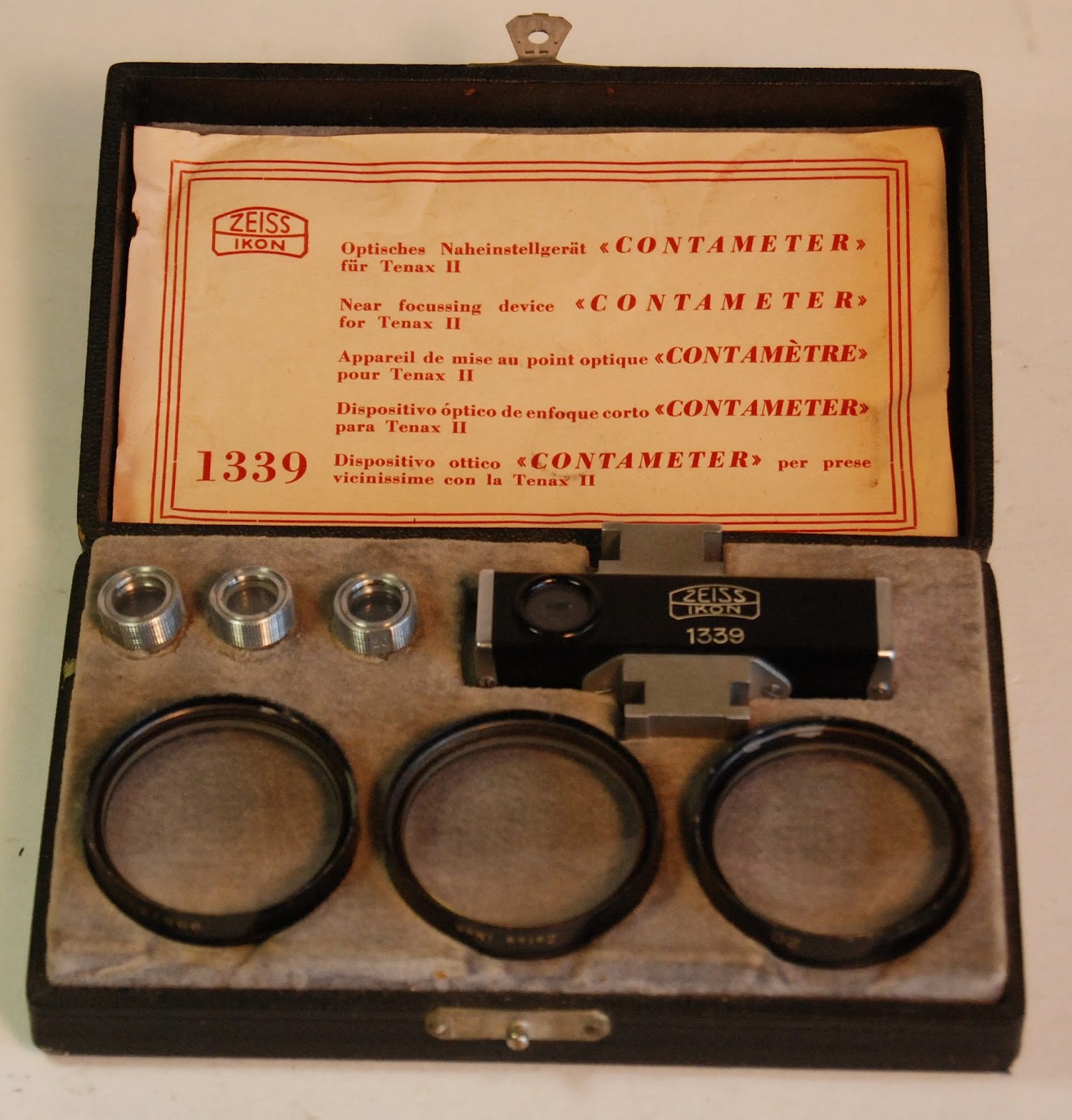
#1339 Contameter in its case


For the Tenax II owner who just had to do closeup photography, Zeiss Ikon offered a few accessories, either the same or modeled on those for the Contax rangefinder cameras.

Contameter 1339 mounted on a Tenax II
The best known was a Contameter, a combination of a rangefinder device and three closeup lenses that came as a kit. Each of the smaller Zeiss cameras had a Contameter designed specifically for that camera and its normal lens. The kit for the Tenax II was #1339. Other kits were #1340 for the Contax III, #1341 for the Super Ikonta B, #1342 for the Super Nettal and Nettax and, the mostly commonly still seen, #1343 for the Contax I and Contax II. At $65 each in 1930s dollars, these kits were expensive.

Each lens has a tiny matched focusing lens that fits onto the rangefinder focusing and framing device that goes onto the accessory shoe. In use, you do not focus the lens, but shift the camera back-and-forth until the rangefinder images match. It is simple to operate and requires no exposure adjustment, but one is limited to only three distances and setting up requires some time.

Bloodroot


Crocus on bloom

Cherry blossoms on Mayapple
 The 37mm slip-on closeup lenses for the Tenax II set consist of a #20, a #30 and a #50. When the 30 and 50 are used, the device mounts using one shoe; When the 20 is used, the Contameter uses the opposite shoe which adds additional tilt for the closer distance parallax. The #20 focuses to approximately 10 1/2 inches or 270mm, for a reduction of 1: 6.75. The #30 focuses to 15 inches or 380mm. The #50 is sharp at 21 inches or 530mm.

Contameter kit 1341 for the Super Ikonta B
Tenax II, 7.5cm Sonnar, #50 CU lens.
 The more widely-available #1341 Contameter can be used on the Tenax II since they both share the same square format and take the same size filters. The rangefinder focuser works with the #50 and # 70 lenses. It does not work with the #20. When the #50 is combined with the 7.5cm Sonnar, it works even better, since that was the focal length the 1341 closeup lenses were designed for.  The Contameter framing however is too wide.  For more information on the 7.5cm f4 Sonnar for the Tenax II go to: 7.5cm for Tenax II

In addition, Zeiss offered two Proxar closeup lenses, numbers 1 and 2. These were quite inexpensive at $5.25 each, but since they came with no framing or focusing, a user would have to use a tape measure to gauge distance.

The camera in these pictures is mounted onto a Micrometer, a device that allowed fine tuning of the distance of the camera from the subject. For more general and historic information on the Tenax II go to: Zeiss Ikon's Action Camera

4cm Sonnar, #50 closeup lens.

7.5cm Sonnar, #50 closeup lens.
 

Tuesday, July 29, 2014

The Nikon rangefinder cameras and reflex housings

50cm f5 Nikkor and the view
This entry covers reflex housings (sometimes called "mirror boxes") that fit and work on Nikon's series of interchangeable rangefinder cameras. You are also welcome to look at my earlier site on the 500mm (50cm) f5 Nikkor in short mount, one of Nikon's early lenses for its reflex housings [http://www.personal.psu.edu/mwl2/500/500Nikkor.htm]. This is a condensation of a series of articles that appeared earlier in the Nikon Historical Society's Journal.

The entries will cover the six housings shown below. All will fit on a Nikon RF camera and allow infinity focus with their own lenses.
 Kilfitt kilfascope with cable, Novoflex, Panflex II, Panflex model 1, Nikon reflex housing, model I, Nikon Housing model II
Each one has its values and idiosyncrasies.

The Kilfascope was one of Kilfitt's second series housings. It has a forty-five degree angled finder that provides a right-side-up and laterally-correct view similar to Kilfitt’s earlier Repriscope. The mirror is spring-loaded in the up position. Pressing down on a button on the left side of the housing lowers the mirror and a connecting cable plugged into the right side holds the mirror in the correct position. This cable screws into the camera’s cable release socket. Pressing down on the button causes the pin to withdraw, releasing the mirror, followed by the firing of the shutter. It is impossible to get out of sync and the action is as fast as the photographer’s finger, permitting rapid firing and film advancing. Re-lowering the mirror is awkward. The view in the finder is reduced but bright with both the landscape and portrait views outlined by overlapping horizontal and vertical boxes. The camera may be rotated, allowing either view to be used without having to turn the housing on its side. Short-mount lenses included a 90mm f3.5, a 135mm f4, 150mm f4.5, 300mm f5.6 and a 400mm f5.6, still famed for their lightness and sharpness. Many were sold with adaptors for use on Arriflex movie cameras. All came in Leica-thread. Focal lengths 150mm and longer will focus to infinity on a Contax-mount housing as seen below. Unfortunately, their single helical focusing rings tend to shift whenever one closes down the diaphragm. In addition, their focusing helicoids turn in the opposite direction of Nikkor lenses in Nikon mount. Early versions of these lenses had manual diaphragms. Later ones were preset. Kilfitt used rubber bands for its focusing and aperture rings. In many cases these have stretched and no longer fit tightly, or are even missing.  In addition, their back rings are so thick that they get in the way of mounting the reflex housing on a large-based tripod.
The 150mm Kilar lens is particularly sweet: light, compact and it takes 52mm filters.

The 300mm f5.6 Kilar in Leica short-mount. Behind is a Novoflex housing also with a 300mm f5.6 lens. These housings have a Contax bayonet in back and Leica thread in front. Both units work on a Nikon rangefinder camera.

Image: Landscape taken with 300mm Noflexar. Note the vignetting, a problem with all long-focus lenses and the Nikon RF cameras.

The Novoflex housing also came in either a waist-level version or one with a fixed 45 degree finder. The 45 degree finder can be rotated 360 degrees, allowing its use from a variety of positions. The mirror box in the Contax/Nikon mount version, 98mm in depth, is deeper then the Visoflex standard, but it still has a Leica thread front mount. The mirror is spring loaded up. A lever on the right side of the box cocks the mirror. A metal bridge release that mounts on the camera links the shutter release to one of two small buttons, one for the horizontal viewpoint, the other for the vertical setting that, in turn, release the mirror. The camera may be rotated for vertical or horizontal and the viewfinder rotates with it in the same way Nikon’s second housing does. In action, this housing is one of the best designed and integrated, but if one is missing the bridge, fast action is impossible. It is not known if Novoflex ever offered a bridge to fit the Nikon rangefinder cameras. Novoflex offered a special bellows that locked onto the housing using its tripod screw. The bellows has the ubiquitous Leica thread mount and Novoflex sold a wide range of barrel mount lenses to go on this bellows, ranging from 135mm through 300mm. Unfortunately, the bellows must be focused using the right-hand knob, the left hand serving as a lock. This limits action photography.
30cm f5.6 Noflexar mounted on the Novoflex reflex housing and Nikon SP. Note the home-made bridge
Wolfgang Jacobi, designer of the Panflex in his office in the 1930s. {courtesy of Zeiss Historica Society).


In addition, the Contax-mount Novoflex housing can take longer Noflexar lenses that use their original fast-focus pistol grip. The rapid-focus bellows in Leica thread mount will take 240mm Noflexars and longer. The Leica-thread Pistol-grip focuser will handle the early 300mm Noflexars and longer focal lengths. The later breech-lock mount focusers will only mount on the Leitz Visoflex II.

The first model of the Panflex and the Nikon Reflex housing, model 1, side-by-side for comparison. Their operation is almost the same, but the Nikon housing looks like a Leitz PLOOT housing.
The Zeiss Panflex was designed for closeup work by Wolfgang Jacobi, a designer of accessories within the WICO department (WIssenschaftliche COntax Photography or Scientific Contax Photography department). It has the external Contax mount on the front, allowing a wide range of Contax/Nikon mount lenses, 85mm and longer to be mounted. The pre-war version did not have any particular lenses in short mount designed for it. A 135mm f4.5 Tessar in short mount was prototyped but never put into production. To change from landscape to portrait view, one must use one or the other of the two 3/8” tripod sockets provided. The view through the fixed finder is laterally reversed and upside down, making any field work challenging. A cable release attaches underneath the side housing, a coupling cable projects out the top. Pressing on the cable release forces up the mirror, then the connecting cable which, in turn, depresses the camera shutter release.   It is similar to Zeiss’ Flektoskop (also a Jacobi design) in shape, finder, operation and view, but smaller. It has the external Contax mount on the front, allowing a wide range of Contax/Nikon mount lenses, 85mm and longer to be mounted.

The post-war Panflex II follows the general pattern of the first Panflex but with a number of definite improvements. The view is laterally and vertically correct. A plunger behind the connecting cable allows picture taking without a cable and without moving the hand off the camera. Unfortunately, the 115mm f3.5 Panflex Tessar was the only lens officially sold for the post-war version and it is hard to find and expensive. The connecting cable requires a shallow-depth adapter when used on a Nikon. The Panflex II is easy to operate and use. The tripod mount rotates from horizontal or vertical.

Nikon (Model I)

Rare and strange. Waist-level finder and body modeled on the Leitz PLOOT model housing, but cable system follows ideas of Panflex model I with a cable release or “Finger-tip” release screwing in below the side housing. In use, you push up, forcing the mirror up, then the connector cable.  View is upright but laterally reversed. Exchanging the finder-tip release for a cable release is inconvenient. The release delay is adjustable. The body can be rotated horizontal to vertical with spring-loaded lock to set position, but the view does not rotate. Instead, a cross-shaped mask over the ground glass allows both views to be seen. The Nikon housings have the greatest depth of any housings, limiting focal lengths to 180mm and longer except for the bellows-mount 135mm.

Although first mentioned in 1952, it appears that the first Nikon reflex housing did not make it to market until late in 1954. Fewer than 200 may have been sold before Nikon replaced it with the Model II in May 1956.

Nikon (Model II)

This last model housing for the Nikon is rounded and finished in crinkle-black. It takes the same connecting cable as Model I, and one can substitute a cable for the Nikon pistol grips. The socket for the release is on top of side and forward. The socket is threaded for an external cable release but only the Nikon “Finger-tip release” or the special cable release will work without modification due to the long, narrow plunger needed to push up the mirror. Mirror is spring-loaded down but the slightest pressure on the release will cause it to start to rise, shifting focus. The is probably the most awkward and user-unfriendly housing for the RF Nikons. Shutter release delay is adjustable. 45 degree finder is removable. A few 90 degree pentaprism finders were made late in the RF period. Viewer is bright with a plain ground glass and is large enough that taking in the entire screen can be difficult. A button on the left side allows camera rotation with a locking position for vertical and horizontal. View in finder shifts with the rotation.